
PIK loans drag implied recoveries for KBRA DLD Direct Lending Index
Apr 02, 2026, 1:00 AM GMT-4 | By Eric Rosenthal | KBRA DLDPIK loans were a meaningful drag on implied recoveries in the KBRA DLD Direct Lending Index last year, pulling the average lower. The tension around PIK is longstanding. Cash is king. PIK defers income and adds incremental leverage, both of which introduce greater repayment risk.
That shows up in the data, though not in isolation. Over the past two years, PIK loans have trailed non-PIK loans on implied recoveries by about 10 points.
In 2025, credits that PIKed a portion of interest had an average implied recovery rate of 41.6 cents on the dollar, compared to 52.6 cents for non-PIK loans. That gap contributed to a decline in the overall Index to 45 cents on average, from 51 cents in 2024.
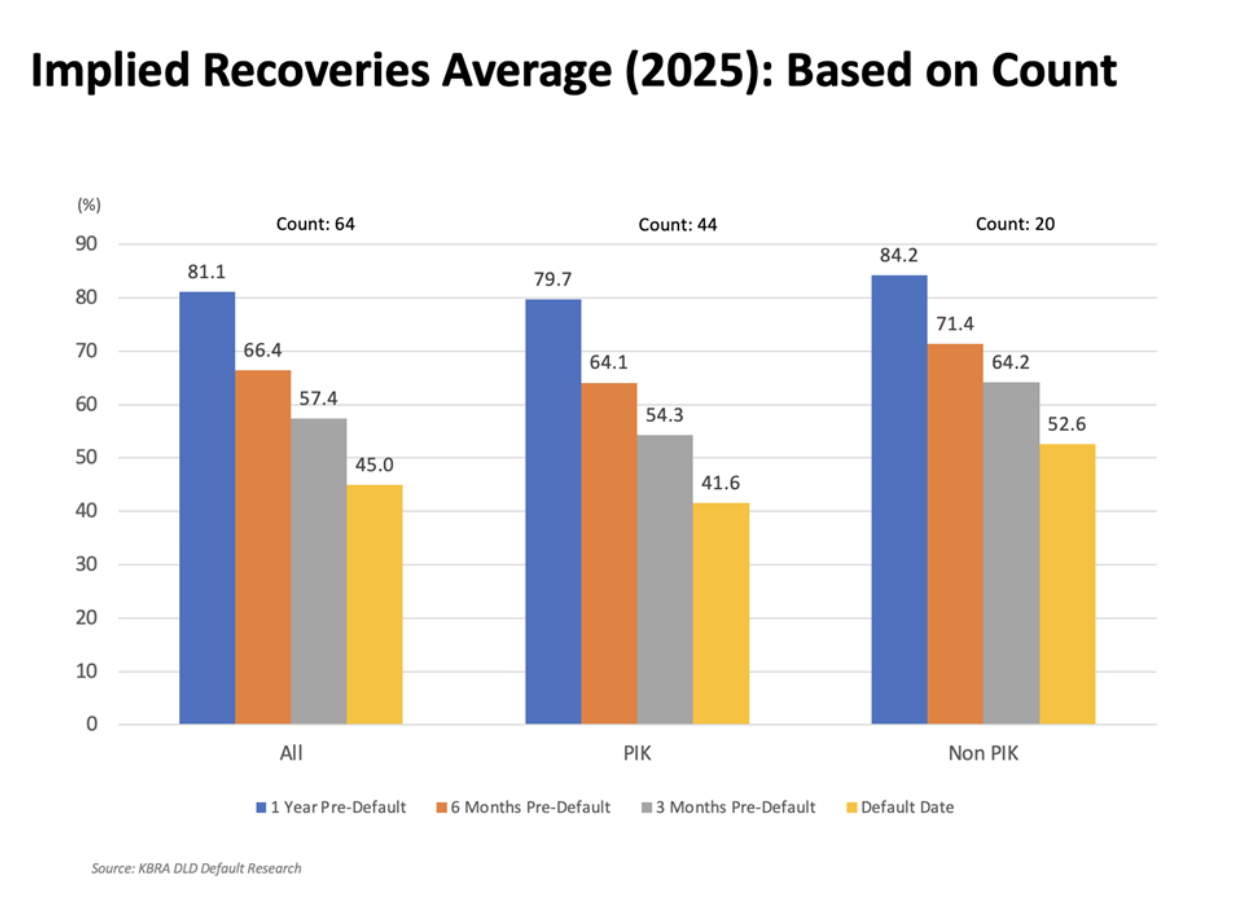
That said, the relationship between PIK and recoveries is not purely causal. Loans that PIK are often those already under pressure or carrying higher leverage, which makes it difficult to separate the impact of structure from underlying credit quality. In that sense, PIK may be as much a signal of stress as a driver of weaker outcomes.
Rates also declined across Non-PIK loans, which were down 4.4 points year-over-year, while PIK loans declined by 5.2 points, according to DLD. PIK underperformed on a relative basis, but the direction of travel was similar across both groups, pointing to a broader credit cycle effect.
Methodology is relevant here. DLD measures implied recovery rates at the point of restructuring—the initial recovery event under the original loan. Managers often point to higher “ultimate” recoveries, particularly where debt is converted into equity and value is realized over time. That’s a fair point, and those outcomes can be meaningful, but they vary widely and may take years to materialize.
From a market standpoint, it’s worth distinguishing how PIK is used. In large-cap private credit, PIK is increasingly embedded at origination for stronger, sponsor-backed credits as lenders compete with the syndicated loan market. With some single-B term loans now pricing under S+300, allowing a borrower to PIK a portion of interest helps align the cash coupon with broadly syndicated levels. By contrast, in the middle market, PIK remains more situational—typically introduced in response to liquidity pressure or as part of a restructuring process. These different use cases likely carry different recovery implications.
PIK is likely to remain part of the toolkit for the foreseeable future. It can provide flexibility both at origination and in periods of stress. At the same time, the data suggests that loans utilizing PIK tend to be associated with lower recoveries on a point-in-time basis, even if the underlying reasons are more complex than structure alone. —Kelly Thompson/Eric Rosenthal