
Software Slump Leading New Issuance to Three-Year Low in Private Credit
Sep 24, 2026, 3:48 PM GMT-4 | By Kelly Thompson | KBRA DLDAnnual new-issue volume captured by KBRA DLD is on track for its lowest level since 2023, when soaring base rates slowed lending.
Volume isn’t expected to fall as low as the $146 billion recorded in 2023, but there is limited runway for a material year-end rebound, and market tone remains soft.
Through Aug. 31, US direct lending volume totaled $126.7 billion, less than half the $327 billion tallied by DLD in 2025 and $305 billion in 2024.
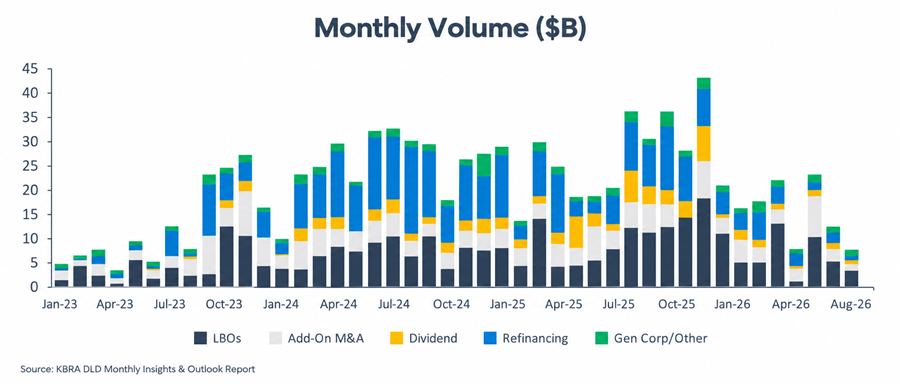
Several factors, including market technicals, are weighing on issuance. But lenders point to two specific factors as having an outsized impact: software and the buyer-seller disconnect.
Software
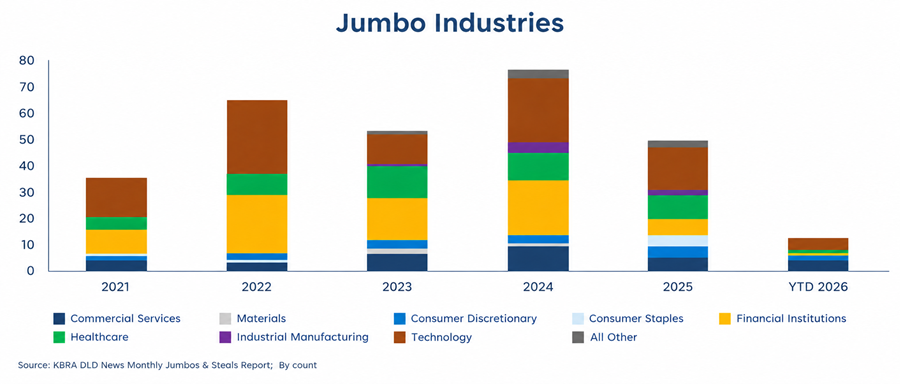
Software has been a major driver of direct lending volume at the large end of the market since the Covid era. For the 2021-YTD 2026 period, software loans of $1 billion or more—what DLD defines as jumbo financings—accounted for about 37% of all jumbo deals.
However, AI fears that erupted earlier this year have erased much of that deal flow.
This year, DLD News has reported just five new software loans of $1 billion or more, down from 18 in 2025 and 25 in 2024. The most recent jumbo software credit—Enverus—surfaced six months ago. (Software is captured as Technology in the chart directly below and the two following charts.)
Credit deterioration has added to sector scrutiny.
Medallia, an enterprise software provider focused on customer and employee feedback, recently completed a roughly $3 billion restructuring.
Quest Software (~$3.5B) and Ivanti (~$2.7B) are other recent examples of software stress, although both are syndicated-loan names.
And, PluralSight’s roughly $1.7 billion restructuring from 2024 remains a reference point as the first major private-market troubleshoot in software.
Want to see more news, data, and research on the direct lending market? Click here to request a complimentary trial of DLD and explore the breadth and depth of our content.
Downmarket
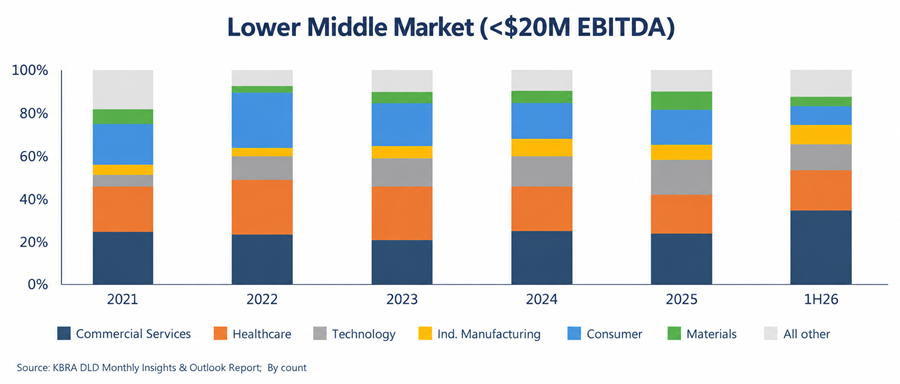
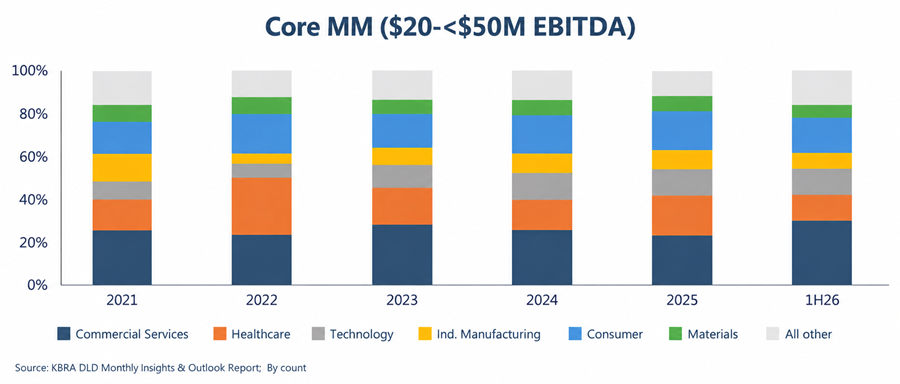
Software is a smaller share of direct lending deal flow in the middle market segments.
In the lower middle market (<$20M EBITDA), software has ranged from 12% to 17% of deal count since 2023, and 12%-14% in the core middle market ($20M-$50M EBITDA).
PE disconnect
Sponsors remain selective sellers, reluctant to unload portfolio companies at lower multiples while simultaneously cautious about overpaying for new assets.
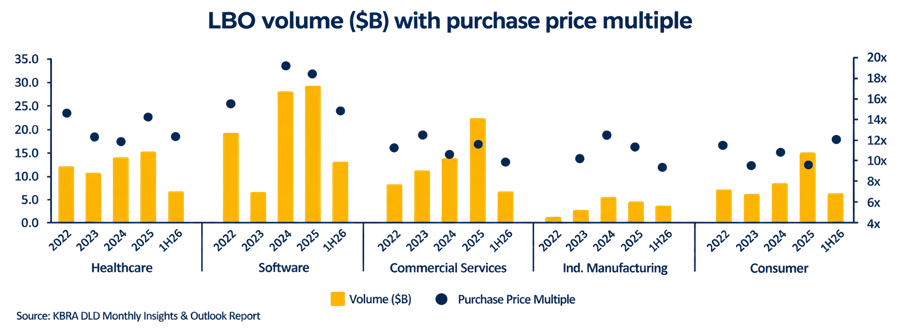
In software, average LBO purchase price multiples fell to 15x EBITDA in the first half of 2026, according to DLD, from 18.4x in 2025 and 19.2x in 2024. Multiples in healthcare, commercial services and manufacturing are down from last year as well.
Pricing pressure
Additionally, sponsors are finding compelling spreads in the liquid credit market. Issuers rated B-/B3 have cleared below S+300 in the past month. Last week, BGIS, a global facilities management and real estate services provider, priced an institutional term loan at S+275 after drawing B-/B3 issuer ratings. In August, Win Waste Innovations priced at S+275 with the same ratings.
In one notable exception, banks last month withdrew a $3 billion refinancing and dividend package for Baker Tilly Advisory Group from the BSL market after investors reportedly pressed for a wider spread.
Baker Tilly’s existing term debt, which was arranged in the private market, is priced between S+425 and S+475, currently the rock-bottom range for direct lending deals. The advisory and tax firm had been seeking materially tighter pricing. Hellman & Friedman and Valeas Capital are equity backers.
In the first quarter, leveraged finance repriced risk around AI concerns, prompting private lenders to widen their best rates to S+500-525. Managers held those levels through the summer as they managed capital amid redemption pressure.
Now, with assets moving to liquid credit, the private market has reset the starting point to about S+450. That level, however, remains confined to the strongest of credits.
Outlook: Not great
The forward pipeline is ghostly, according to lenders. Absent a meaningful pickup by mid-October, there will be little runway for a year-end rebound in new issues.
A successful large-cap PE execution could catalyze activity, but the fourth-quarter setup is challenging: Base rates reversed course this week with a 25-bps increase, inflation is persistent, and energy costs continue to rise due to the war in Iran, which began in late February and has no clear end in sight.
The good news
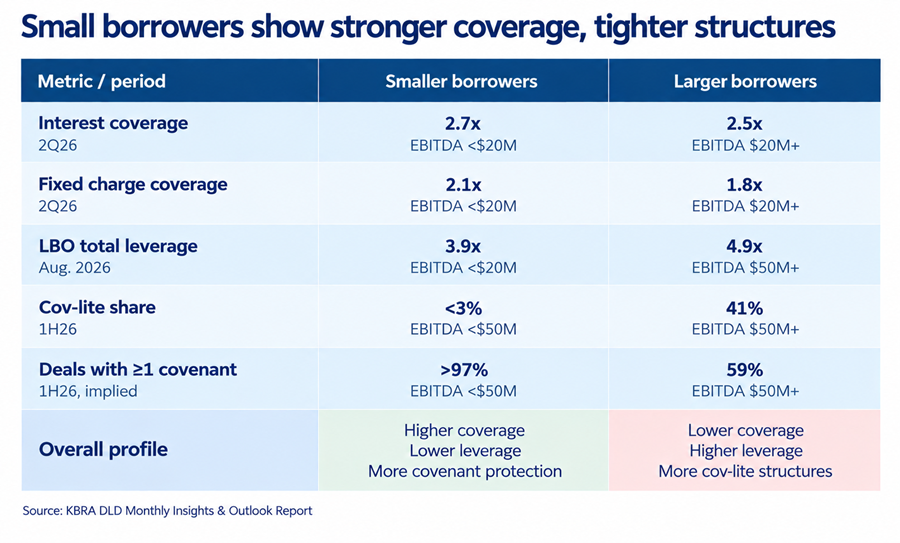
KBRA DLD estimates roughly 75% of the $1.7 trillion direct-lending universe is middle market—a more stable segment, better cushioned from the volatility seen at the large end, where borrowers of scale can move between private and liquid credit. Terms also remain more disciplined, as the table below broadly illustrates.
Defaults also remain modest, at 2.2% of the KBRA DLD Direct Lending Index, with a loss given default rate of about 1%. That said, the forward indicators are less benign: DLD's Default Radar watch list is steadily growing, while implied recoveries are averaging only about 54%. — Kelly Thompson