
America’s Smallest Standalone Bank Closes After 106 Years
Jul 13, 2026, 9:00 AM GMT-4 | By Frank GarganoKentland, Indiana-based Kentland Federal Savings and Loan Association (FSLA) was shuttered by the Office of the Comptroller of the Currency (OCC) on Friday, July 10, marking both the third and the smallest bank failure of the year.
Following the OCC’s appointment of the FDIC as receiver, substantially all deposits and assets of the $3.73 million bank will be acquired by Kentland Bank (KFI Score: C), also based in Kentland, Indiana. At the time of its failure, Kentland FSLA reported $3.65 million in deposits, and according to an OCC press release, had “experienced substantial dissipation of assets and earnings due to unsafe and unsound practices.”
“The bank is critically undercapitalized, and there is no reasonable prospect that the bank will become adequately capitalized,” the OCC statement said.
In its March 2025 OCC Community Reinvestment Act (CRA) Performance Evaluation of Kentland FSLA, regulators noted that the bank’s size directly impacted its ability to compete against other banks for loans and deposits in its assessment area. Furthermore, the evaluation highlighted that the bank’s “ability to originate loans is challenged by a very high loan-to-deposit (LTD) ratio due to its small volume of deposits, and a low level of capital, resulting in a very low legal lending limit.”
Since 1Q 2025, Kentland FSLA maintained a KFI Score of E, correctly forecasting that the institution was likely to experience financial problems. Further evidence supporting the score includes a 2023 consent order from the OCC against the bank, wherein the bank was subject to supervisory restrictions and revisions to its board of directors, asset risk exposure, leverage ratios, and other operational areas.
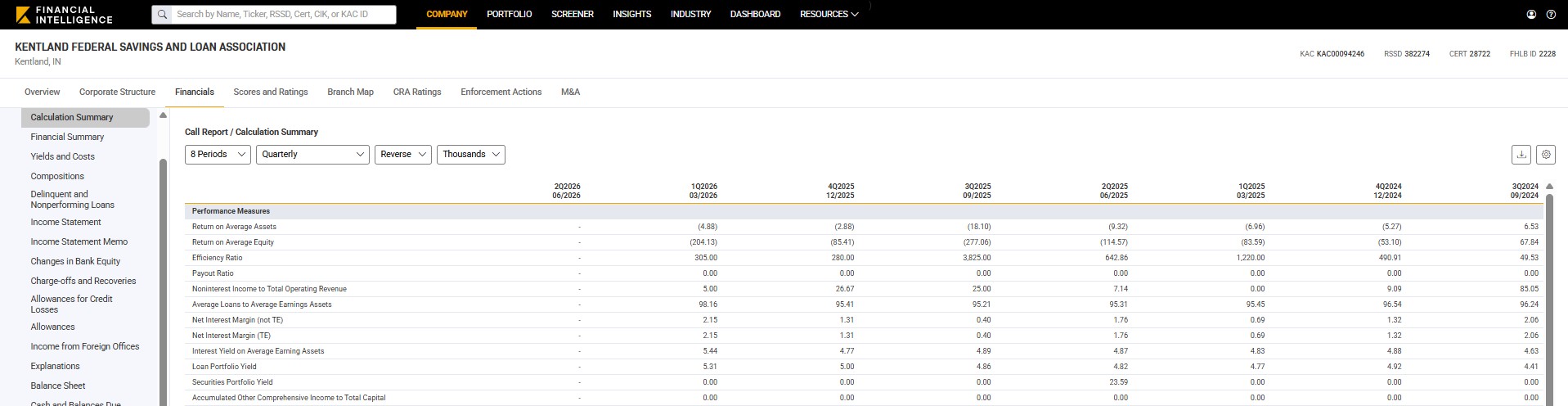
Call report data collected by KBRA Financial Intelligence (KFI) show that over the last six quarters, Kentland FSLA posted losses in return on average assets and return on average equity. Uninsured deposits also hovered around 8% to 10% for the bank since 3Q 2025.
The previous bank failure this year occurred in May, when LaGrange, Georgia-based Community Bank & Trust - West Georgia was shuttered by the Georgia Department of Banking and Finance. At the end of fiscal year (FY) 2025, roughly 44% of the bank’s lending composition was concentrated within the commercial and industrial (C&I) sector. Over all four quarters, the bank charged off more than $5.8 million in C&I loans, pushing the net charge-off ratio to 7.79% in 4Q from 2.86% in 1Q.
Individual bank delinquency rates, charge-offs, and loan compositions can be viewed via KFI’s web app, as well as through our Excel add-in’s Loan Category and Delinquency Report template.
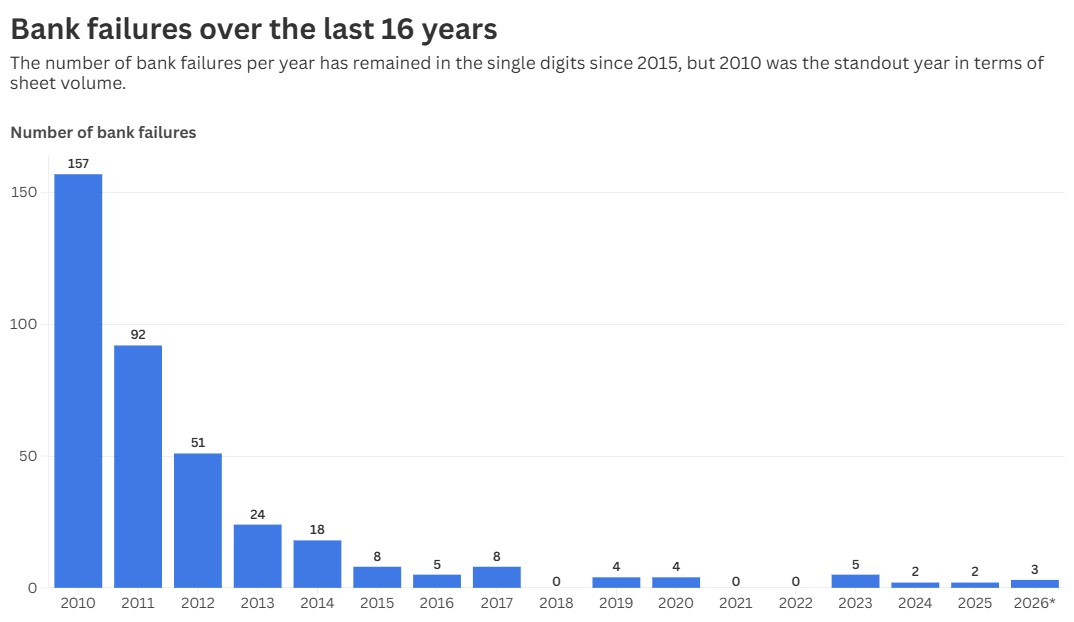
Over the last 16 years, KFI tracked and scored 383 banks before their closures. Of that total, 95% of banks that failed from 2010 through year-to-date (YTD) 2026 had a KFI Score of D or lower before closure by the FDIC, correctly identifying those institutions as being in irreparably poor financial condition, according to KBRA Financial Intelligence (KFI) data.
Source: KBRA Financial Intelligence (KFI)
Looking at the data, there were 157 bank failures in 2010, the highest figure during the date range, followed by 51 failures in 2012, 24 failures in 2013, and 18 failures in 2014. Since then, bank failures have generally remained in the single-digit range.
Sources: KBRA Financial Intelligence (KFI), FDIC
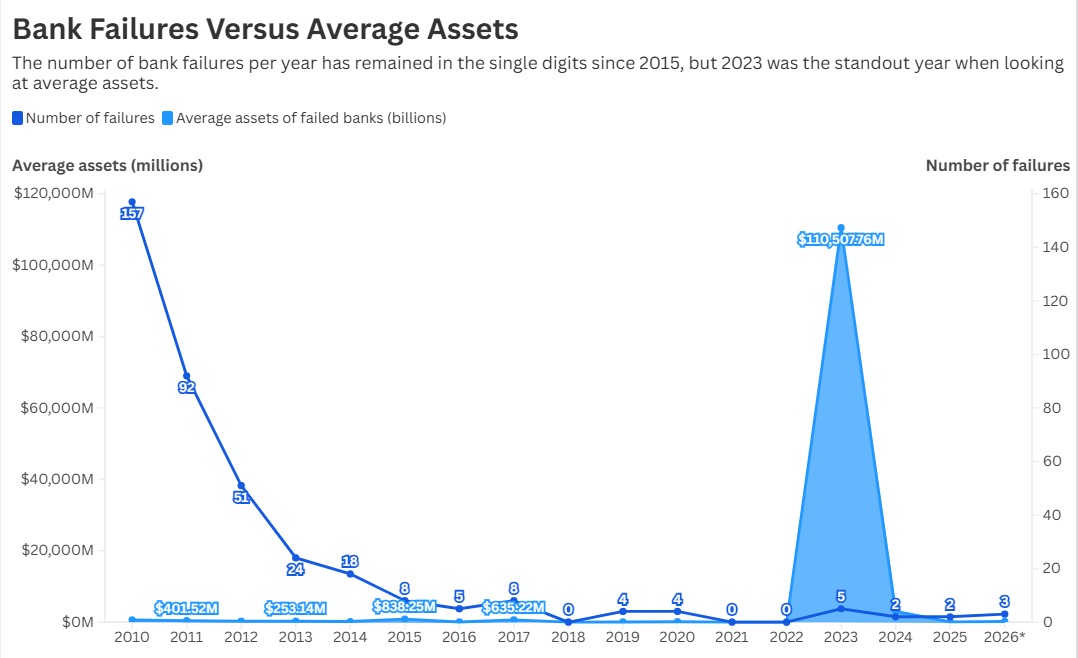
When looking at the average total assets of failed banks per year, despite 157 failures in 2010, the average for the year was only $614.7 million. By comparison, the average for 2023 was $110.5 billion.
Note: Commentary and opinions expressed by individuals who are not affiliated with KBRA Analytics do not necessarily reflect the views of KBRA Analytics, KBRA, or their employees. Such commentary is included solely to provide relevant industry perspectives.