
How Could the Bipartisan Housing Bill Upend Mortgage Lending for Banks and Credit Unions?
Jun 29, 2026, 10:00 AM GMT-4 | By Frank GarganoAs the 21st Century ROAD to Housing Act nears President Donald Trump’s desk this month, bank and credit union leaders are already beginning to map out how several key provisions could impact mortgage lending programs.
The bipartisan legislation passed in the House of Representatives by a vote of 358-32, continuing the momentum set forth by the Senate’s 85-5 affirmative vote on Monday.
Trump was set to sign the act into law on June 24, but called off the formal ceremony in a post on his Truth Social account, explaining his decision to hold off “until such time as we pass the desperately needed SAVE AMERICA ACT, which I consider to be a National Emergency,” he said in the social media post.
A sitting president has exactly 10 days (excluding Sundays) to either sign or veto a bill presented to them. According to these same constitutional articles, the bill will become law after the 10-day period has elapsed if Congress remains in session and Trump does not issue a formal veto.
Housing Market by the Numbers
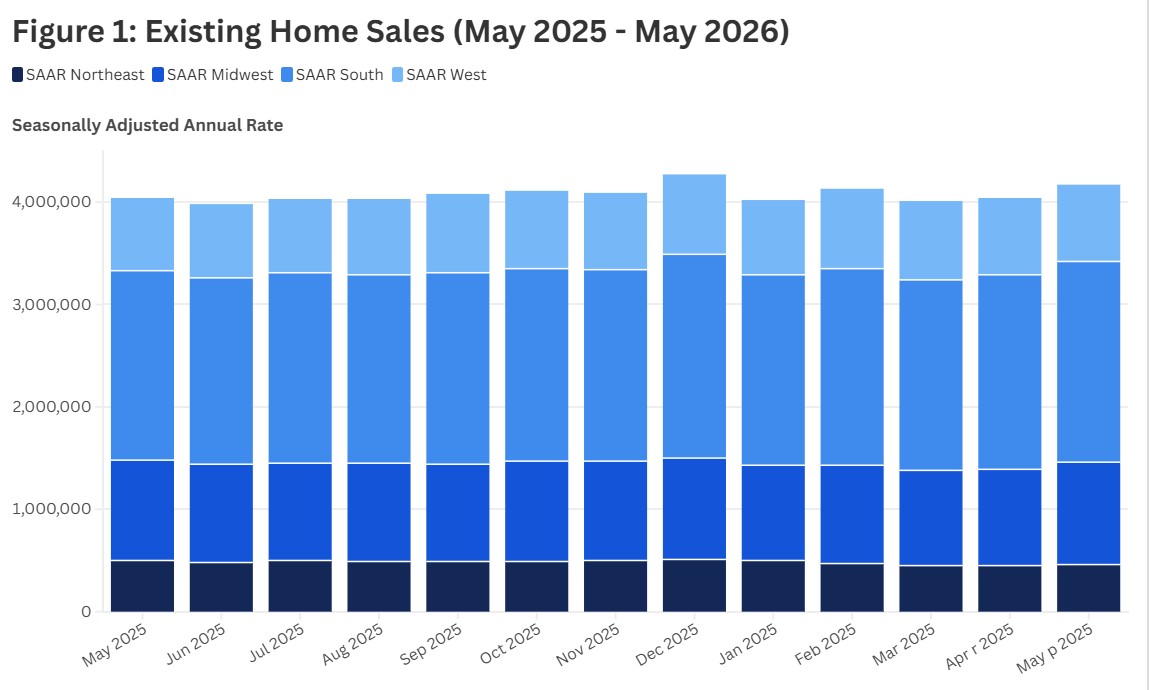
Source: National Association of Realtors, Existing Home Sales May 2026
Existing home sales have continued to trend higher across the U.S., according to newly released housing data by the National Association of Realtors(NAR), detailing existing home sales for May and the prior 12-month period. For the country, sales were up 3.2% for both month-over-month (MoM) and year-over-year (YoY) periods on a seasonally adjusted annual rate basis.
Broken down by region, the Northeast was up 2.2% from April but down 8% from the year-ago period. The Midwest was up 6.4% MoM and 2% YoY. The South was up 3.2% MoM and 5.9% YoY. The West recorded no MoM growth but was up 5.6% from May 2025.
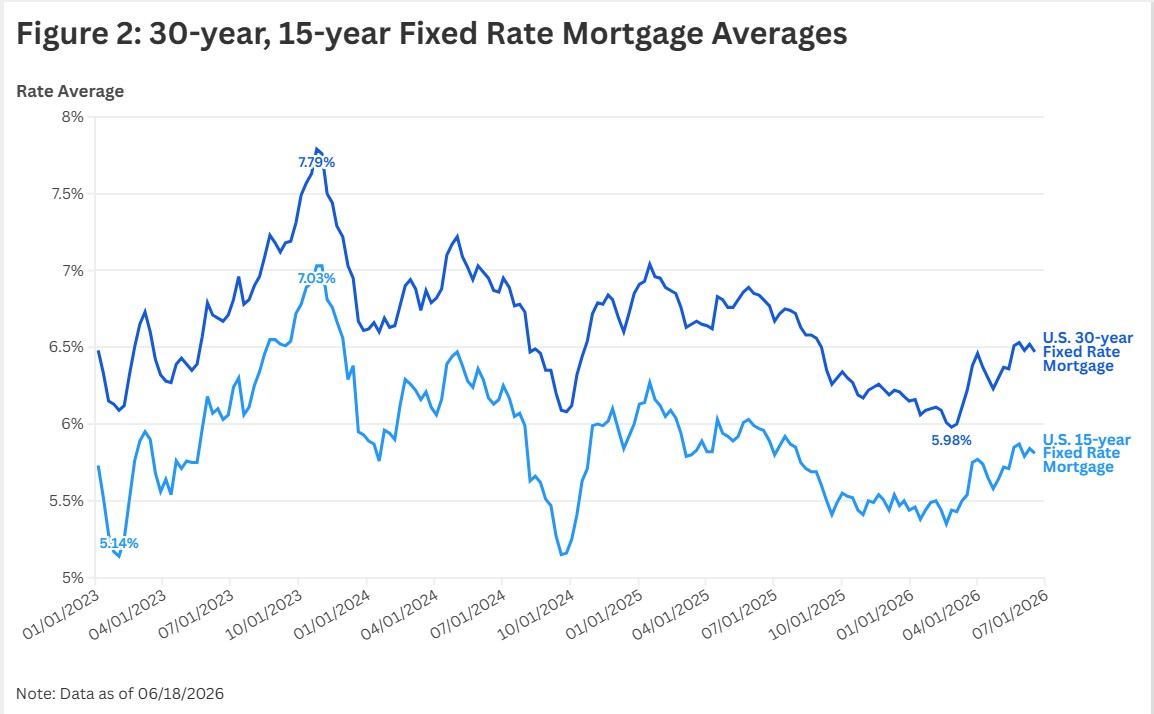
Source: Freddie Mac, Primary Mortgage Market Survey
Dr. Lawrence Yun, chief economist at NAR, stated in a press release that “more Americans are on the move, with home sales rising to the highest level since December,” a trend he said is helped in part by “improving affordability.”
“Even with mortgage rates ticking up compared to earlier in the year, they remain lower than a year ago and are essentially at the long-term historical average,” Yun said. “Income gains are also outpacing home price growth by a small margin in most parts of the country.”
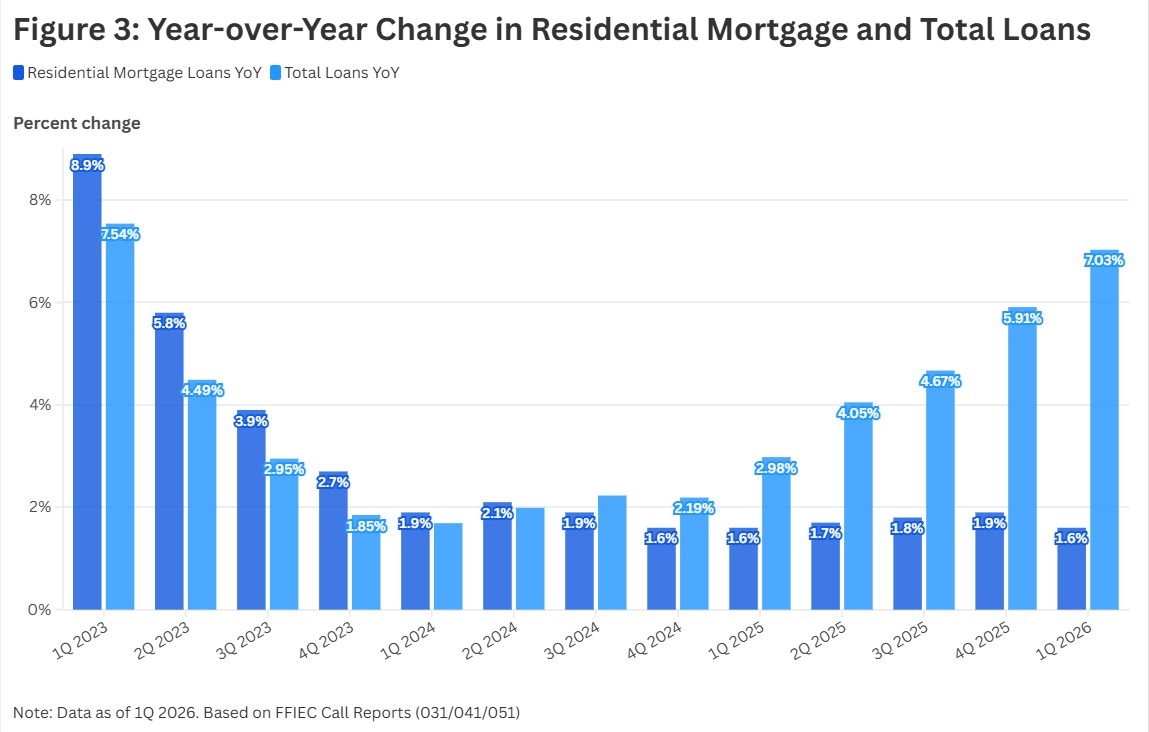
Source: KBRA Financial Intelligence (KFI)
Looking across the last three years of data, we see that total loans have continued to post YoY growth since 1Q 2025, while residential mortgage figures have seen little change over the same period.
Important Provisions Bankers and Credit Union Leaders Should Know
Here are five provisions within the housing package that are of key importance for banks and credit unions.
Community Investment and Prosperity Act (Sec. 203): For banks supervised by the Office of the Comptroller of the Currency and the Federal Reserve, the public welfare investment cap would be raised to 20% from 15% to “enhance banks’ capacity to make private investments in affordable housing,” according to a section-by-section summary issued by the Senate subcommittee on Banking, Housing, and Urban Affairs.
Importance for financial institutions: Qualifying banks could invest deeper into affordable housing, community development organizations, and Low-Income Housing Tax Credit (LIHTC) projects. Expansions of Community Reinvestment Act efforts are also possible.
Small-dollar mortgage originator incentives (Sec. 401): Defines a small-dollar mortgage as a loan with an original principal balance of $100,000 or less secured by a one- to four-unit property occupied by the borrower and insured by the Federal Housing Administration (FHA), U.S. Department of Veterans Affairs (VA), U.S. Department of Agriculture (USDA), or eligible for purchase/securitization by Fannie Mae or Freddie Mac. In addition, the director of the Consumer Financial Protection Bureau (CFPB) would examine loan originator compensation practices throughout the residential mortgage market.
Importance for financial institutions: Depending on the CFPB’s findings, the bureau could adopt rule changes that improve the small-dollar mortgage market for community banks, credit unions, Community Development Financial Institutions (CDFI), and rural lenders.
Small-dollar mortgage points and fees (Sec. 402): The director of the CFPB, in conjunction with the Secretary of Housing and Urban Development (HUD) and the director of the Federal Housing Finance Agency (FHFA), would evaluate the impact of qualified mortgage points-and-fees thresholds on small-dollar mortgage originations. This section defines a small-dollar mortgage as a loan with an original principal obligation of less than $100,000.
Importance for financial institutions: Adjustments to these thresholds could relieve the pressure on banks and credit unions looking to expand further into the lower-balance lending market without a blatant need to overhaul underwriting practices.
Appraisal modernization (Sec. 704): Adds a requirement for the VA, FHA, USDA, and the FHFA to implement and maintain a requirement that creditors of federally backed mortgage loans have a review and resolution procedure for consumer-initiated reconsiderations of value or subsequent appraisals.
Importance for financial institutions: The addition of a required review and resolution process could noticeably affect compliance workflows, appraisal review policies, fair lending controls, vendor management, and documentation standards.
Property Improvement and Manufactured Housing Loan Modernization Act (Sec. 303): Would update mortgage lending standards for manufactured housing through the FHA while also expanding access to housing financing options. Additionally, it would direct HUD to evaluate the cost-effectiveness and long-term value of “supporting housing finance for factory-built housing,” according to the summary.
Importance for financial institutions: Updated lending standards could pave the way for banks and credit unions to wade deeper into manufactured housing financing through FHA-related avenues.
Note: Commentary and opinions expressed by individuals who are not affiliated with KBRA Analytics do not necessarily reflect the views of KBRA Analytics, KBRA, or their employees. Such commentary is included solely to provide relevant industry perspectives.