
Could a Soft Jobs Report Fuel Talk of a Rate Hike in the Near Future?
Aug 12, 2026, 12:00 PM GMT-4 | By Frank GarganoUnemployment figures from the U.S. Bureau of Labor Statistics (BLS) were little changed month-over-month (MoM) for July, but looking back over the past 12 months shows a different picture for the broader financial services sector.
The unemployment rate improved to 4.1% in July, down from 4.2% in June, alongside national job losses of 23,000 for the month.
Construction (22,000), health care (22,600), information (11,000), and other industries notched job gains for the month, while retail trade (-19,400), financial activities (-14,000), hospitality (-40,000), and government (-53,000) recorded notable job losses.
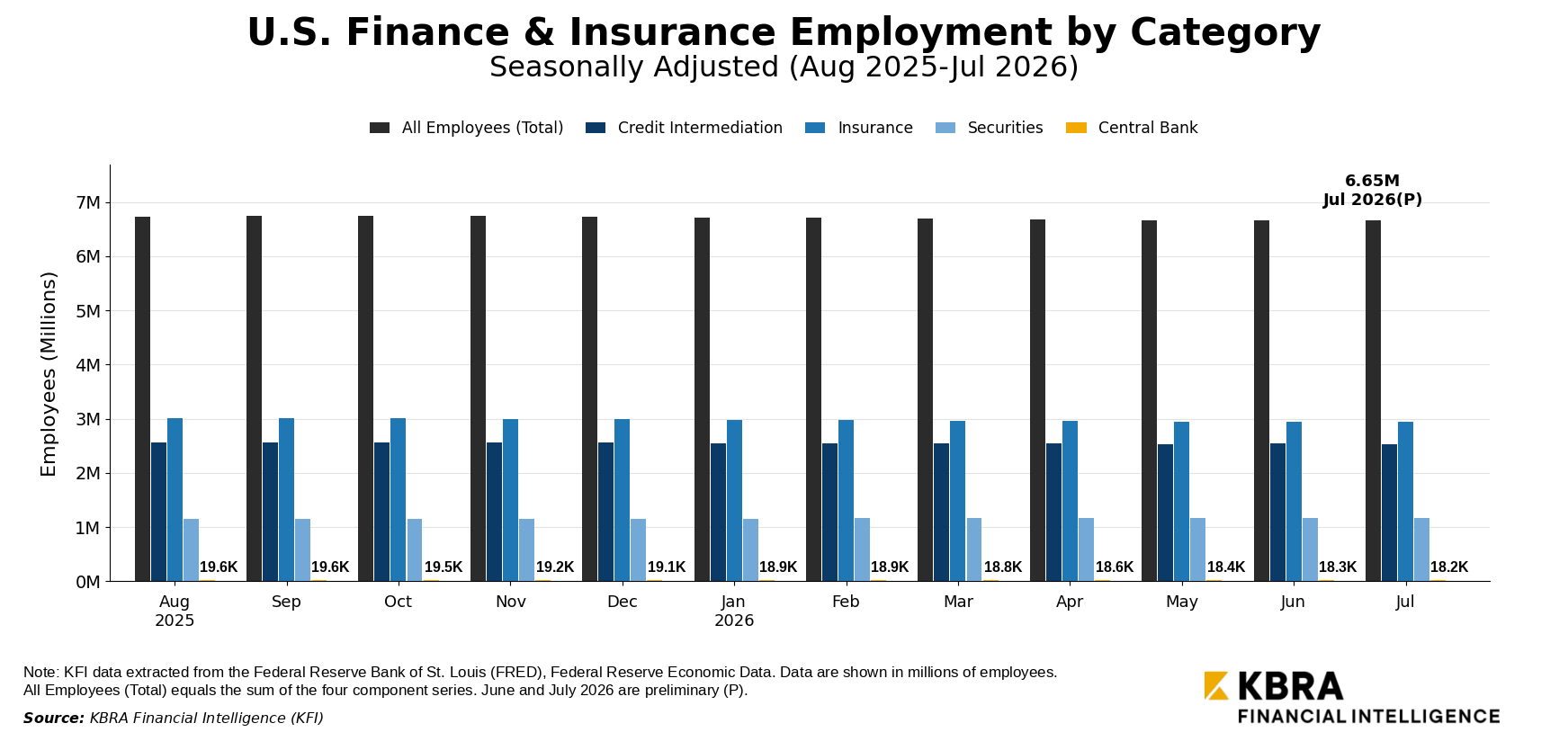
Seasonally adjusted employment figures within the finance and insurance sector have trended downward over the past 12 months, with a year-over-year (YoY) loss of 1.2% or 81,200 jobs.
Across the same period and broken down by industry, employment in credit intermediation and related activities was down 1.4%, or 34,900 jobs; employment in insurance was down 2.3%, or 69,800 jobs; employment in securities and related activities was up 2.2%, or 24,900 jobs; and employment in the central bank sector was down 7.1%, or 1,400 jobs.
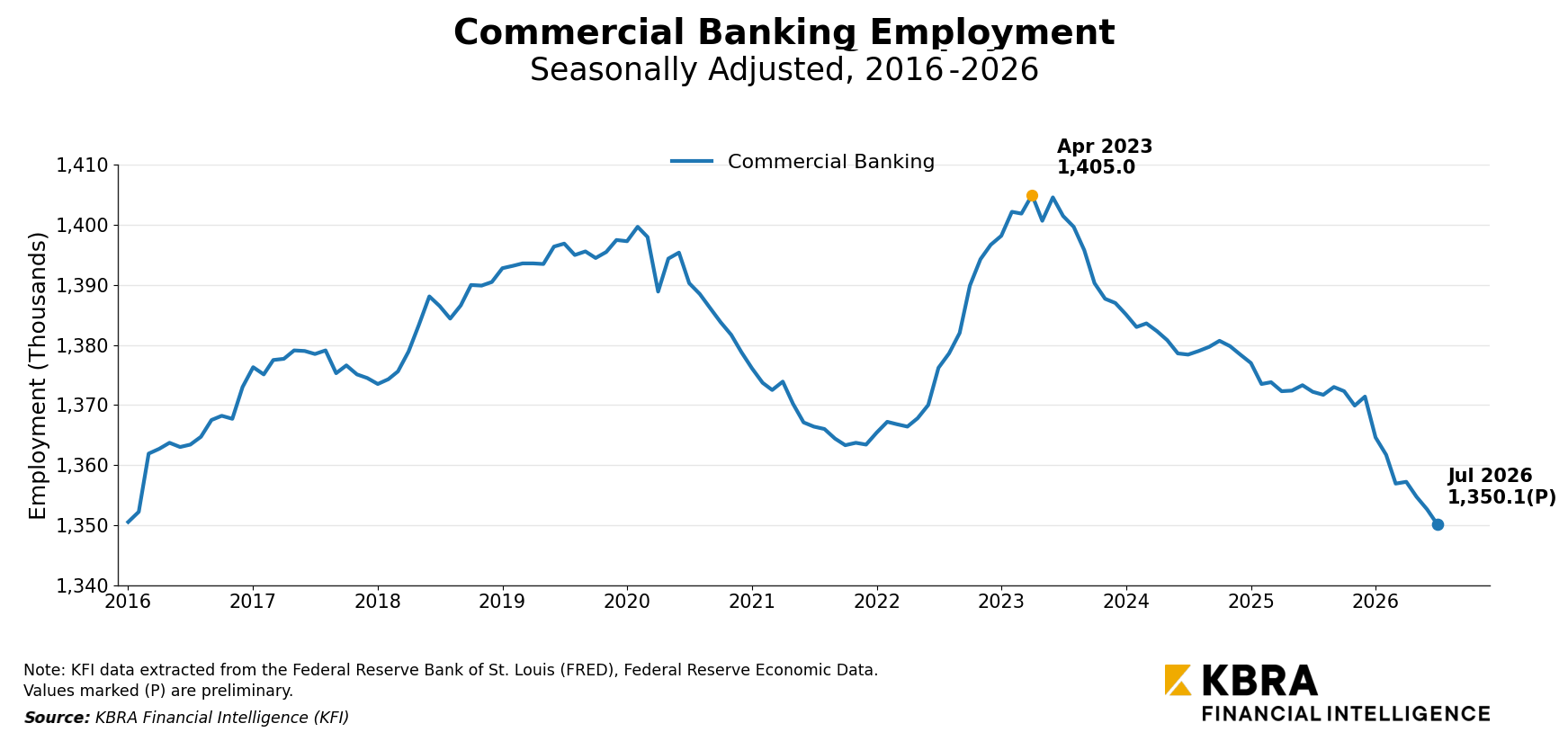
Drilling deeper into the July report shows that employment in the commercial banking sector has mostly declined over the last three years, shedding roughly 55,000 jobs over this period.
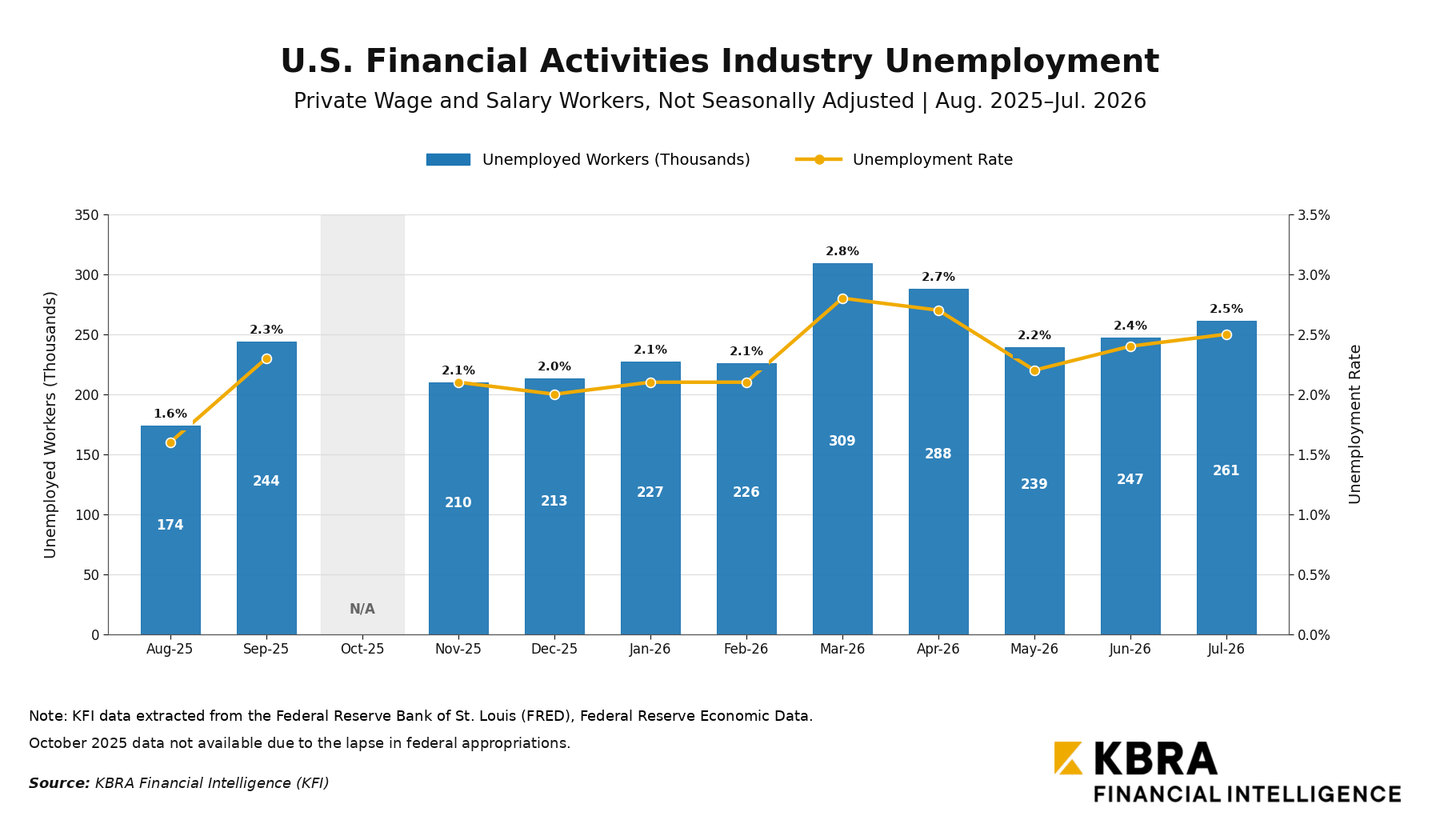
Looking at the data for the broader financial activities sector, which accounts for real estate and rental and leasing in addition to finance and insurance, both the unemployment rate and the number of unemployed workers hit their 12-month peaks in March 2026 at 2.8% and 309,000, respectively.
The unemployment rate fell to 2.2% in May, but then increased MoM to 2.5% in July, with 261,000 unemployed workers.
“Financial activities employment is down by 121,000 since a recent peak in May 2025,” according to the BLS.
What Changemakers at the Federal Reserve Are thinking
Speaking earlier this month at the 2026 Economic Luncheon of the Anchorage Economic Development Corporation in Anchorage, Alaska, Fed Governor Lisa Cook said that despite the labor market being in a “low-hire, low-fire environment,” inflation remains “stubbornly high.”
“Inflation is too high, and I consider the risks to the inflation side of the dual mandate higher than the risks to the employment side at this point,” Cook said. “As such, I am prepared to act by raising rates, if necessary.”
Cook elaborated that, in deciding whether to support a rate hike, she would “consider how a rate increase could negatively affect” the stability of the “labor market and output growth,” but that the decision ultimately comes down to the necessity of bringing down inflation.
“With five years of above-target inflation, the risk grows that higher inflation may become entrenched in price- and wage-setting behavior, leading to persistence that would be much harder for us to attack,” Cook said.
Maximum employment and price stability are the two objectives of the Fed’s dual mandate, which guides how the agency sets policy.
During a July event hosted by the Stanford Institute for Economic Policy Research, Fed Vice Chair Philip N. Jefferson said that the combination of the supply shock created by the conflict in the Middle East and the unemployment rate at that time is characteristic of a policy dynamic in which the “dual-mandate objectives are not aligned but rather in tension with each other.”
Still, Jefferson supported the decision to leave the Fed’s target rate unchanged in July as the best course of action for “support[ing] the labor market while allowing inflation to resume its decline toward our 2 percent target as the effects of past tariffs and energy prices pass through completely,” he said.
Note: Commentary and opinions expressed by individuals who are not affiliated with KBRA Analytics do not necessarily reflect the views of KBRA Analytics, KBRA, or their employees. Such commentary is included solely to provide relevant industry perspectives.