
Federal Reserve Holds Rates Steady Amid Strong Economic Performance
Oct 29, 2026, 12:00 AM GMT-4 | By Frank GarganoMembers of the Federal Open Market Committee (FOMC) left rates unchanged this month amid strong expansion in economic activity, productivity growth, and capital investment.
“As we widen the frame to survey the broad economic and financial picture, real activity is clearly pointing in the right direction,” Fed Chairman Kevin Warsh said during the FOMC press conference. “But inflation is too high.”
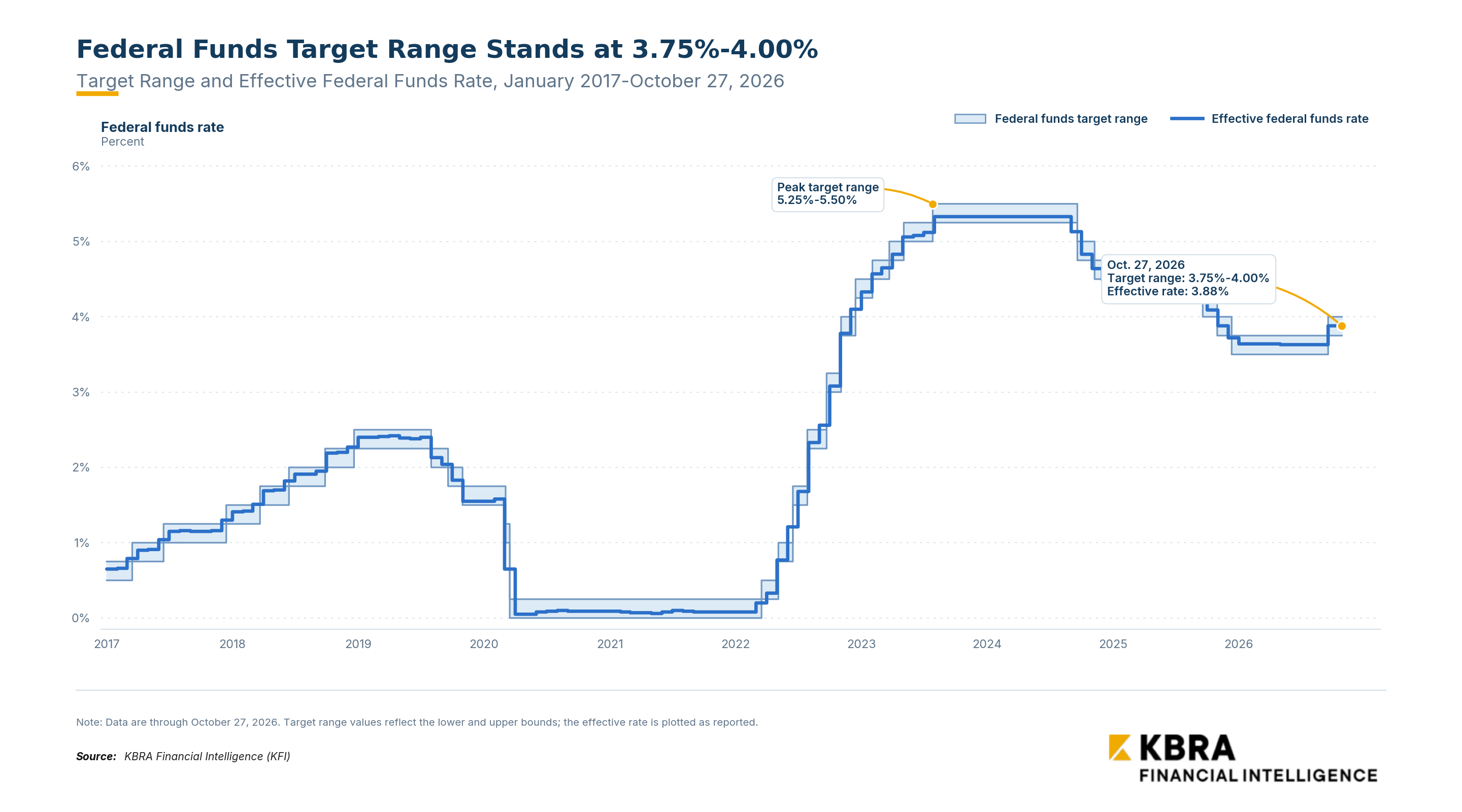
Members of the FOMC voted 10-2 to leave the target range for the federal funds rate at 3.75%-4.0% “in support of the Federal Reserve’s dual mandate,” according to the October 28 press release announcing the decision. The two dissenting votes were from Fed Governors Lisa D. Cook and Beth M. Hammack, who both agreed a 25-basis point (bp) hike was the best course of action.
American Banker’s Kyle Campbell sat down with KBRA Financial Intelligence (KFI) last month to discuss how the Federal Reserve has changed under Chairman Kevin Warsh, the potential long-term impact of changes to forward guidance and communication, and the impact of the rate hike.
Campbell highlighted how there was initial market uncertainty as to whether Warsh and the FOMC would follow through on commentary being published that supported calls for a hike, especially considering how a hike would be the first rate action taken by Warsh during his administration. But there were “market signals in the days leading up to the FOMC meeting that [a rate hike] was broadly expected,” he said.
“They followed through unanimously, which I thought was noteworthy since we had heard a little bit of a range of opinions about what would actually trigger a rate hike, whether it would take an actual move up in inflation or just a persistently high level on par with recent months,” Campbell said. “We got the latter, and it turned out to be enough for a hike.”
One notable change Warsh talked about included shrinking the number of yearly FOMC meetings to eight starting in 2027, with one of those meetings focused exclusively on “broad monetary policy strategy” and “with neither a vote on the federal funds rate nor policy statement anticipated,” he said. This balance is expected to shift further in 2028, with six traditional FOMC policy meetings and two strategy gatherings devoid of voting activity.
“Getting policy right involves assessing near-term developments at timely, regular, and information-rich intervals,” Warsh said. “But it’s equally important we reserve time and space as an intellectually diverse group for strategic deliberations. It’s yet another change to get the conduct of monetary policy on the right track.”
Market Performance by the Numbers
Inflation/Interest Rates
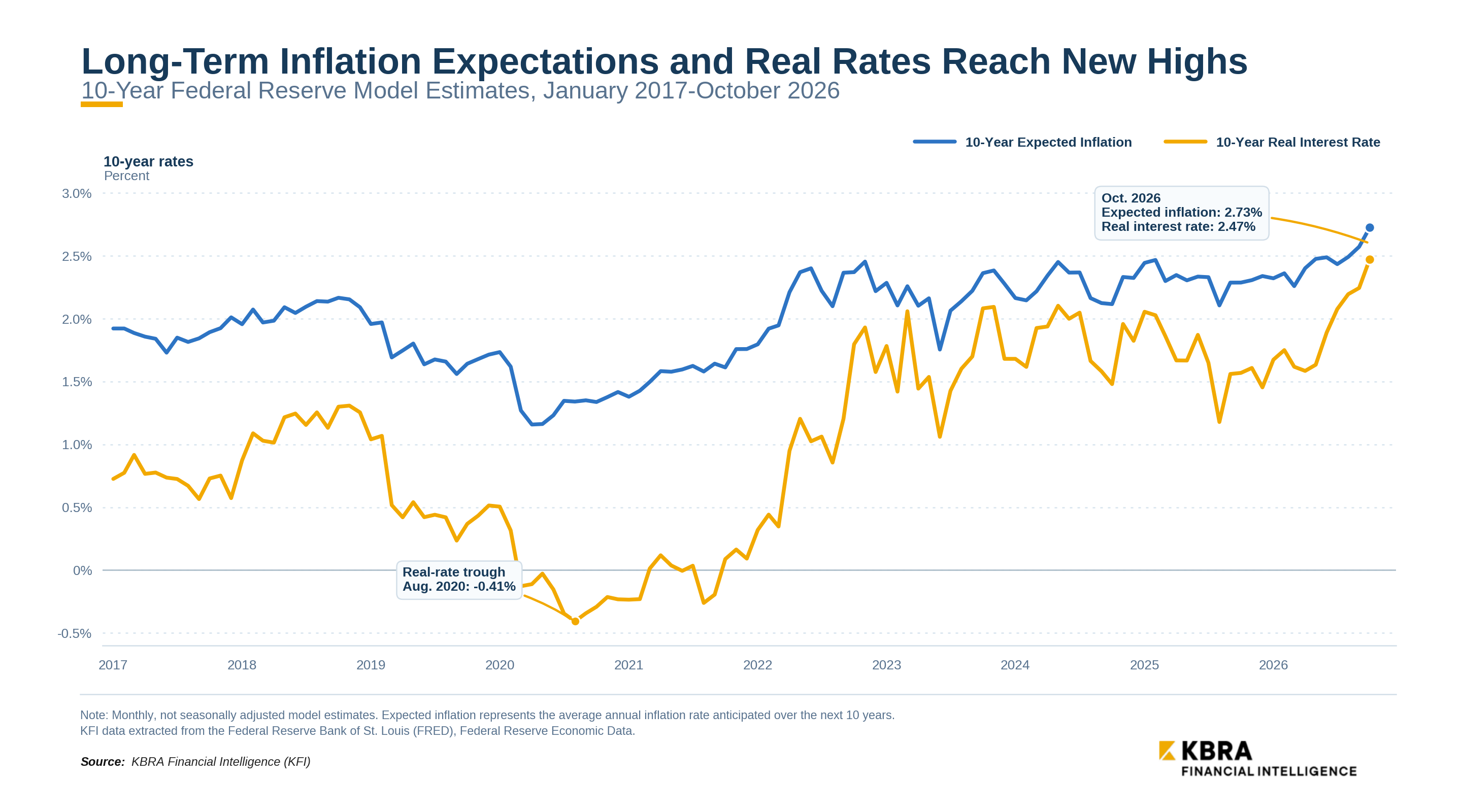
KFI analysis of the latest numbers from the Federal Reserve Bank of St. Louis found that the 10-year expected inflation and real interest rates were 2.7% and 2.5% for October, up roughly 6% and 10.2%, respectively. Both rates have continued to steadily climb since October 2025’s lows of 2.1% for expected inflation and 1.2% for real interest rates.
The rates for both expected and real inflation were at their lowest points in the range during mid-2020, as economic shocks from the COVID-19 pandemic saw consumer spending drastically fall off. In the following years, the introduction of President Donald Trump’s tariffs created upward pressure on inflation, which we see in the mid- to late-2025 period as both figures increased once again.
Members of the FOMC voted unanimously to raise the target range for the federal funds rate by 25 bps to 3.75%-4.0% last month, part of broader efforts to support the Fed’s dual mandate, as “inflation remains elevated” and the Fed “policy action will support a timelier return to the Committee’s 2% goal,” according to the September press release.
When asked by a reporter whether this month’s decision to hold rates steady could establish a belief among consumers that the Fed does have a soft inflation target, Warsh adamantly dispelled that such a benchmark exists.
“There’s no soft inflation target, there’s no implicit inflation target, there’s a target for price stability and it’s 2% as measured by PCE,” he said. “Households, businesses, financial markets, they have the confidence that they should have that the central bank will deliver price stability.”
Treasury Yields
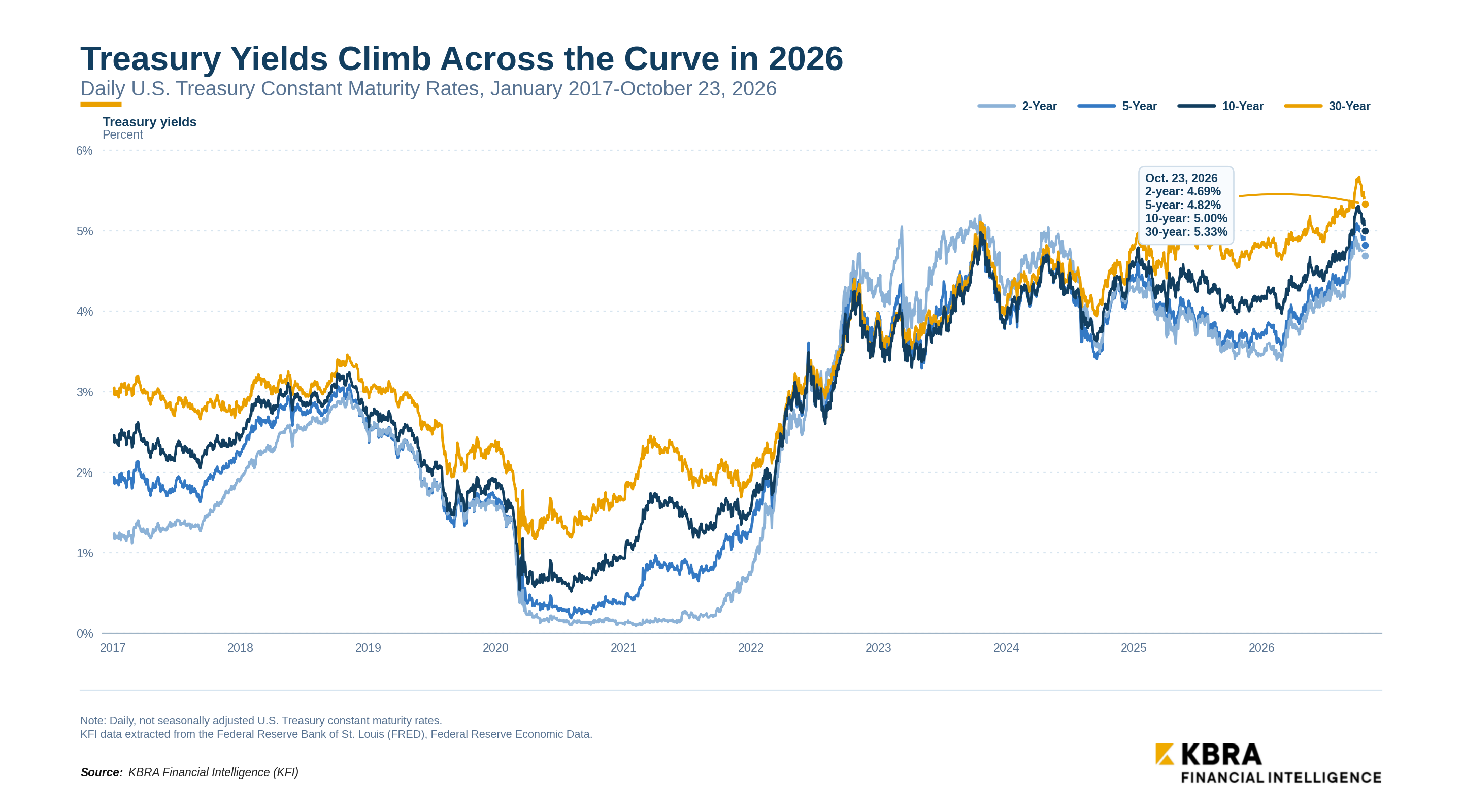
Market yields quoted on an investment basis for 2-year, 5-year, 10-year, and 30-year notes were generally trending upward since Warsh took office in June. But following the September 16 FOMC meeting where the rate hike was announced, yields have generally started to fall.
Between September 16 and October 23, yields on 2-year notes were down 1.1% to 4.69%, down 80 bps on 5-year notes to 4.82%, down 20 bps on 10-year notes to 5%, and down 40 bps on 30-year notes to 5.33%.
Personal Consumption Expenditures (PCE)/Core PCE
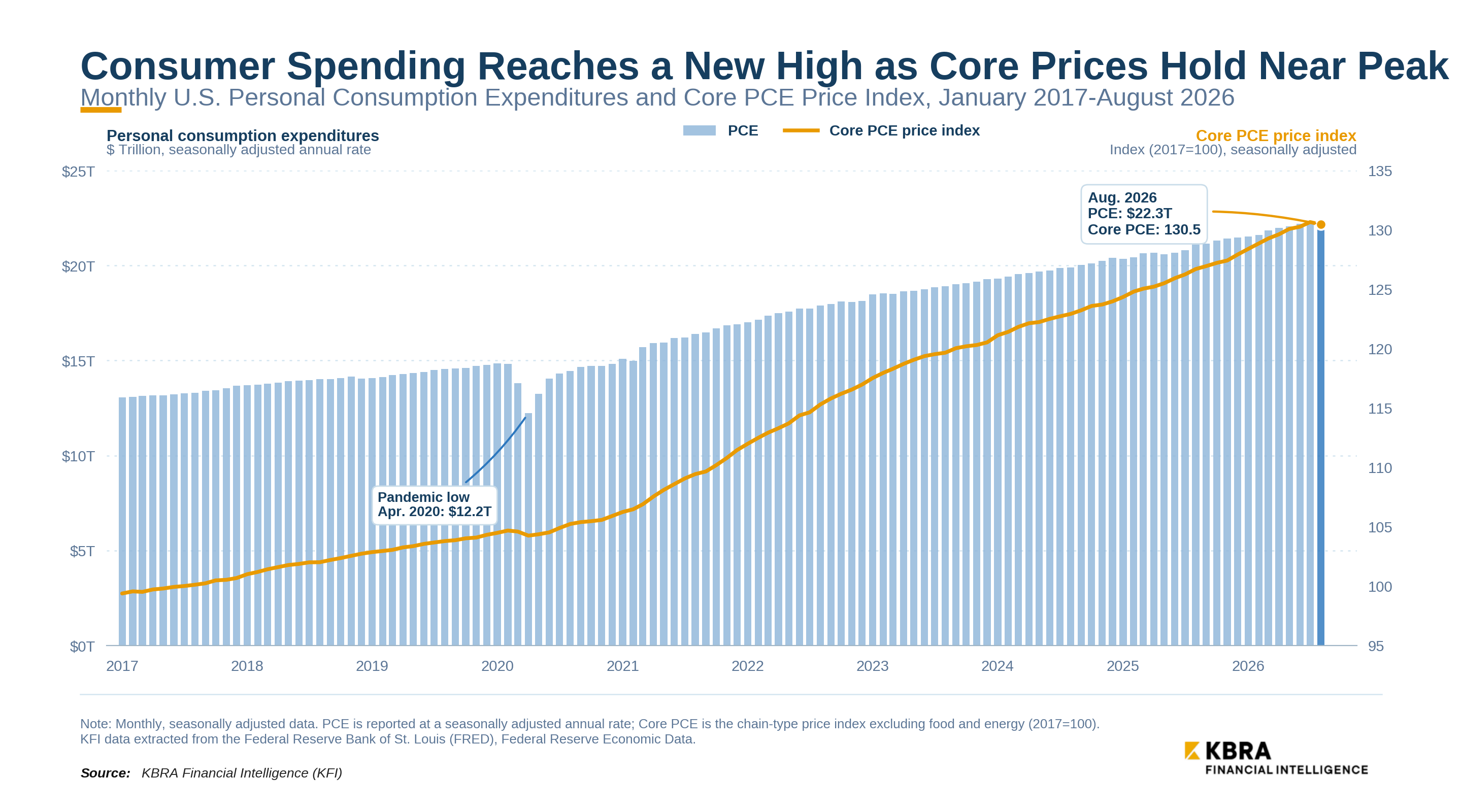
PCE climbed slightly to $22.31 trillion in August, up roughly 30 bps from $22.25 trillion the month prior and roughly 5.7% year-over-year (YoY). Core PCE, which excludes food and energy, dropped 20 bps to 130.46 in August but is up close to 3% YoY.
Note: Commentary and opinions expressed by individuals who are not affiliated with KBRA Analytics do not necessarily reflect the views of KBRA Analytics, KBRA, or their employees. Such commentary is included solely to provide relevant industry perspectives.
Stay informed with KFI Insights
Get the latest research and analysis on banking industry trends, financial data, and developments impacting U.S. banks and credit unions delivered directly to your inbox.
Subscribe here: https://go.kbra.com/KBRA-KFI-Marketing-Insights.html