
Federal Reserve Holds Rates Steady Despite Tariff Pressures
Jul 30, 2026, 12:00 PM GMT-4 | By Frank GarganoMembers of the Federal Open Market Committee (FOMC) left rates unchanged this month, with Federal Reserve Chairman Kevin Warsh concluding that economic shocks from tariffs and the ongoing war in the Middle East have not been enough to deter economic performance.
A majority of the FOMC voted to keep the target range for the federal funds rate at 3.5%-3.75% in support of the Fed’s dual mandate, as “job gains have kept pace with the workforce, and the unemployment rate has changed little,” according to the FOMC statement issued Wednesday.
Dissenters included Beth M. Hammack, Neel Kashkari, and Lorie K. Logan, who voted instead to raise the benchmark interest rate by 25 basis points (bps).
The discussions during this month’s FOMC meeting centered on four themes, according to Warsh’s opening statement at the press conference on Wednesday, July 29: i) the impact of the last five years of high inflation on policy decisions; ii) economic shocks stemming from military conflicts and tariff rate increases; iii) price increases resulting from those shocks; and iv) monetary policy tools and strategies for accomplishing price stability.
In this month’s press conference, Warsh highlighted how inflation “remains elevated relative to the Committee’s [two] percent goal” and reaffirmed the Committee’s core objective to “deliver price stability.”
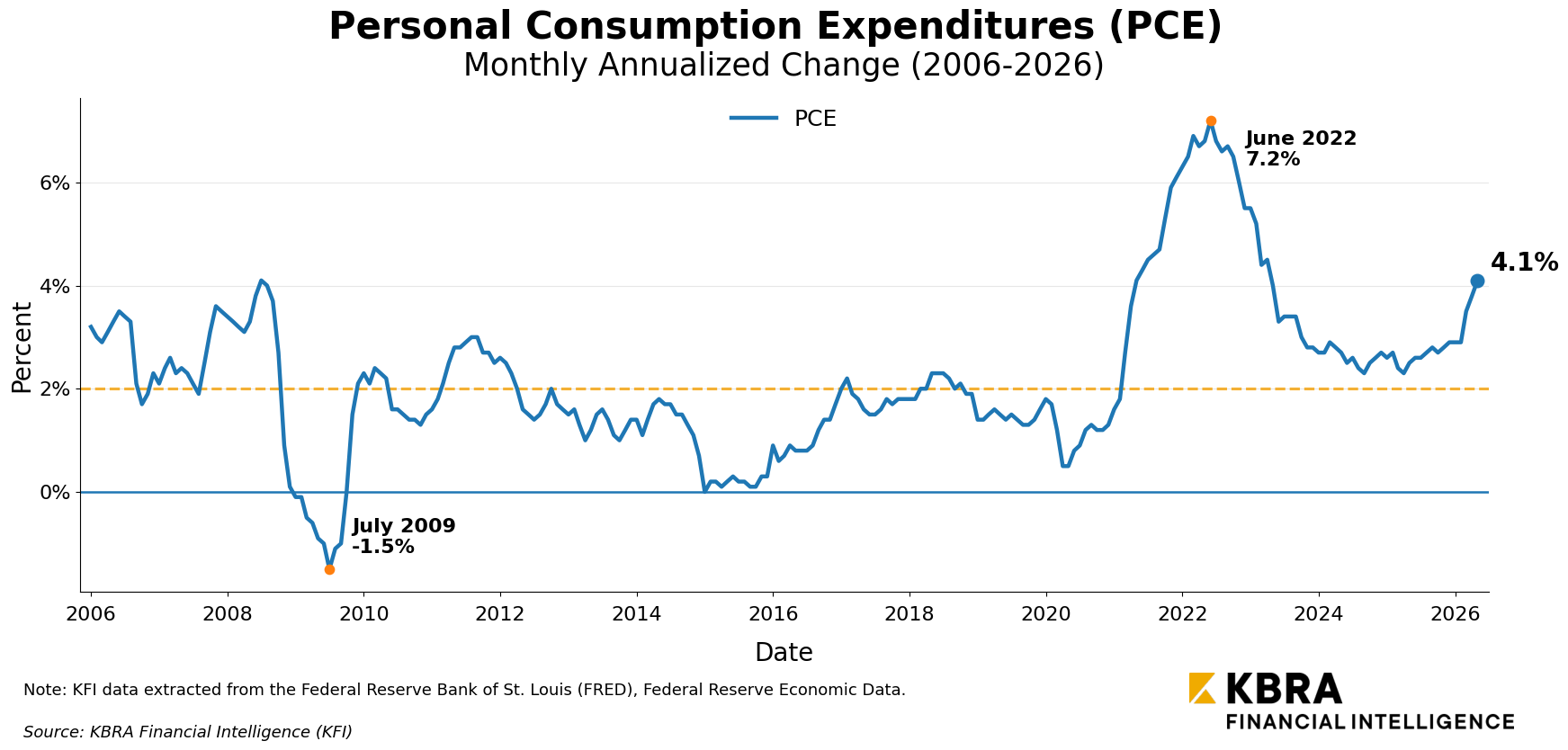
The latest figures from the Federal Reserve Bank of St. Louis on personal consumption expenditures (PCE) show PCE has remained above the Fed’s 2.0% target since March 2021, with a high of 7.2% in June 2022 and a low of -1.5% in July 2009.
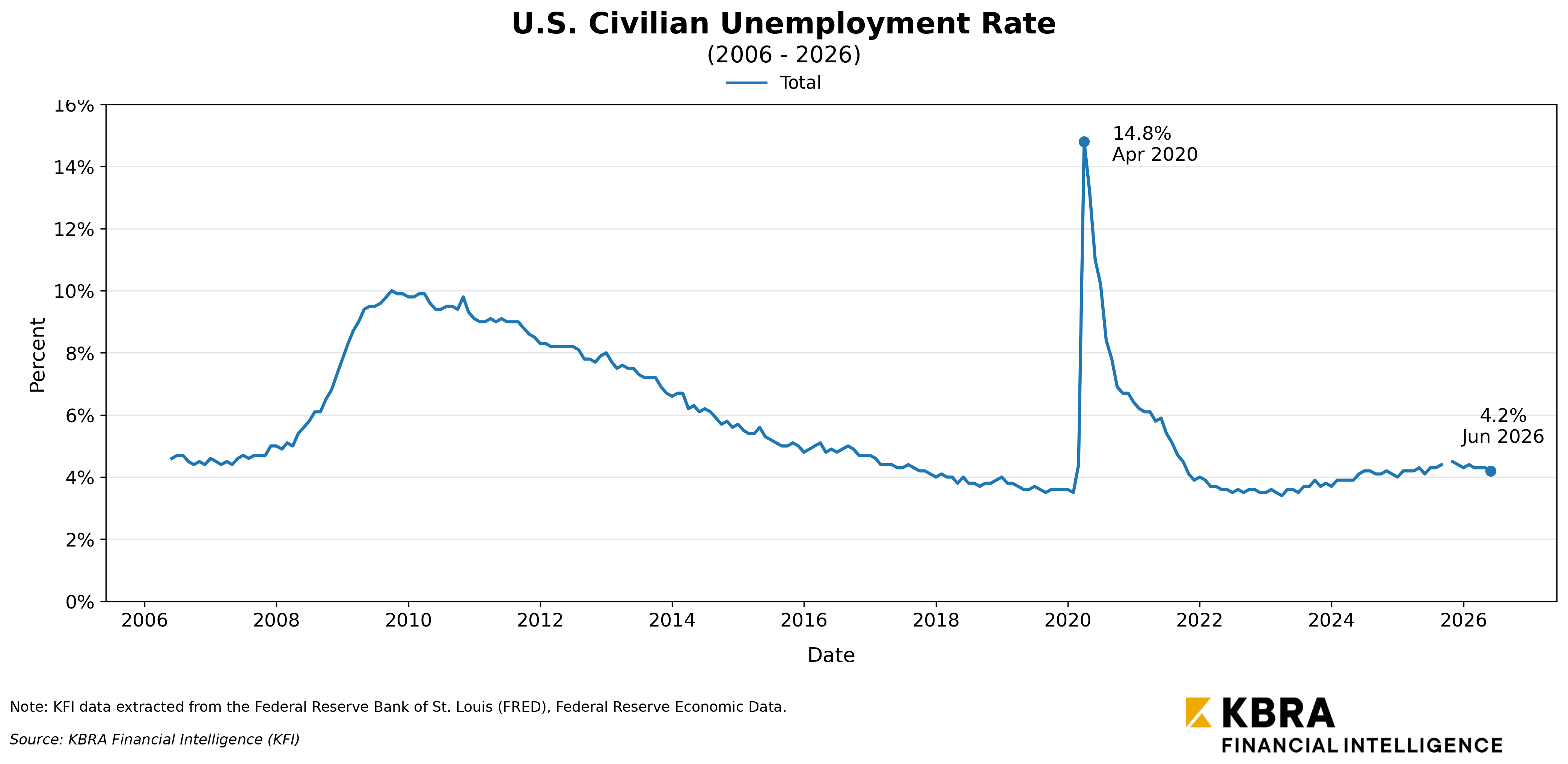
The unemployment rate has remained above 4.0% since June 2024 and currently stands at 4.2% as of [July 2026]. Although unemployment has changed little since the start of this year, it has fallen sharply from its peak of 14.8% in April 2020.
Warsh remarked that the last five years of elevated inflation have “left a mistaken impression” among households that the Fed has an “implicit inflation target [that] was somehow above [two] percent,” an idea he quickly dispelled.
“Let me reiterate: There is no soft inflation target, there is no soft implicit target—not on this Committee’s watch,” Warsh said. “There is only a target, and it is [two] percent.”
Warsh also highlighted that nominal and real yields were “materially higher across the Treasury curve” between the June and July FOMC meetings, which he said could be partly due to the pullback in issuing forward guidance.
“Market participants are learning to play the ball, not the referee, and market prices will continue to respond in the direction and magnitude they see fit,” he said.
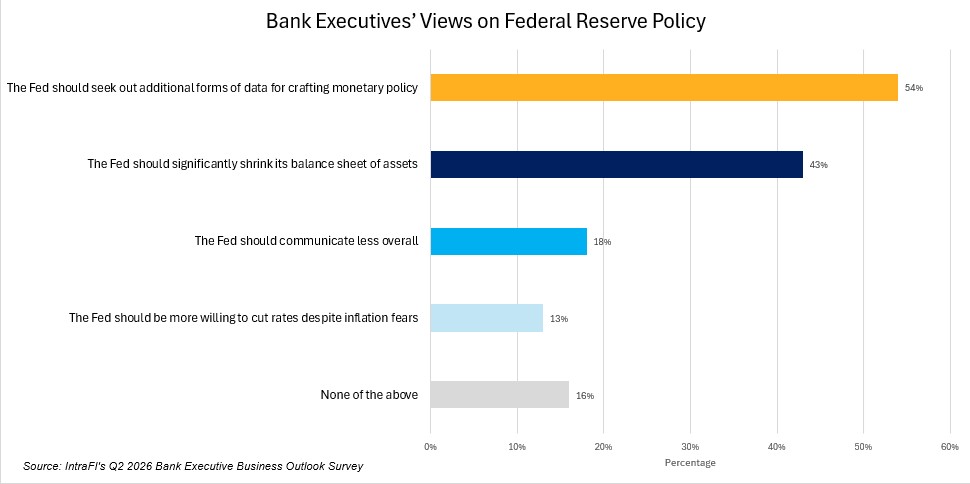
Findings from IntraFi’s 2Q 2026 Bank Executive Business Outlook Survey of more than 400 executives show that more than one-half of respondents (54%) agree that the Fed should seek out additional forms of data when crafting monetary policy. Roughly 43% of respondents said the Fed should significantly shrink its balance sheet of assets, 18% said the Fed should communicate less overall, and 13% said the Fed should be more willing to cut rates despite inflation fears.
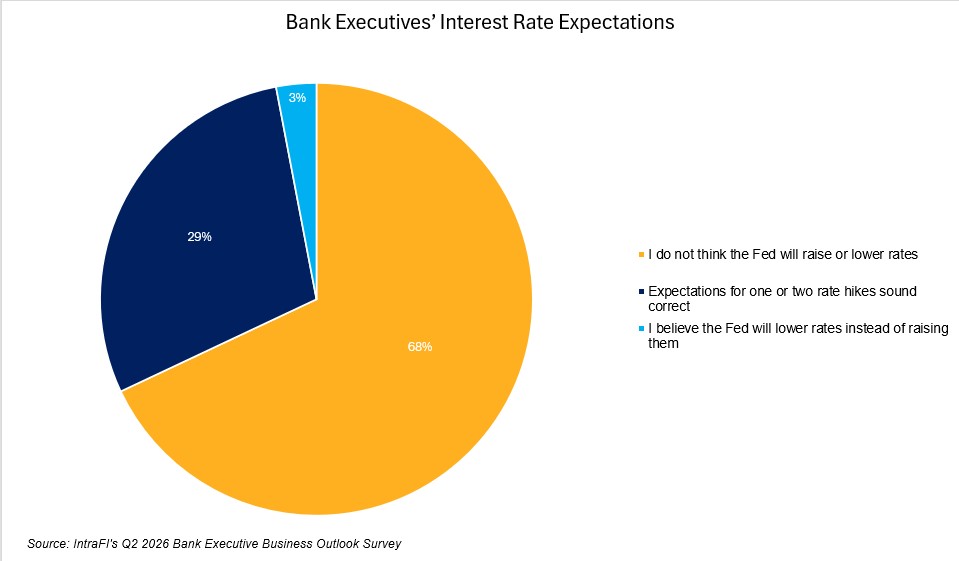
When asked how interest rates will shift throughout the remainder of the year, 68% do not believe the Fed will change rates, 29% said expectations for one or two hikes sound correct, and 3% said the Fed will lower rates instead of raising them.
The Fed’s dual mandate of price stability and maximum employment has weathered inflationary pressure from tariffs and the ongoing war in the Middle East, but some FOMC members believe these variables will likely result in only a short-lived increase in inflation.
Speaking at a July 15 event at the Exchequer Club of Washington, D.C., Federal Reserve Governor Lisa Cook said that while she voted with the FOMC to hold rates steady, risks “continue to be strongly weighted toward higher inflation.”
Cook specifically mentioned tariffs and the Middle East war as two core factors driving heightened inflation risks. Under normal economic conditions, economists would expect the resulting supply shocks to have only a temporary, one-time effect on inflation. However, the current elevated inflationary environment introduces new risks.
“Firms’ pricing and wage decisions may depend more on what inflation has been rather than its source—implying a risk that the high inflation we have seen boosts inflation going forward,” Cook said. “Nevertheless, I am comforted that medium- and long-run inflation expectations appear mostly anchored.”
Note: Commentary and opinions expressed by individuals who are not affiliated with KBRA Analytics do not necessarily reflect the views of KBRA Analytics, KBRA, or their employees. Such commentary is included solely to provide relevant industry perspectives.