
Loan Quality, Consent Order Were Key Factors Behind the Second Bank Failure of 2026
Jun 17, 2026, 10:00 AM GMT-4 | By Frank GarganoLaGrange, Georgia-based Community Bank & Trust - West Georgia was shuttered by the Georgia Department of Banking and Finance on Friday, May 1, marking the second bank failure of the year.
Following the appointment of the FDIC as receiver, substantially all insured deposits and certain assets of the failed $288 million-asset bank are due to be acquired by Anchor Bank (KFI Score: B), based in Palm Beach Gardens, Florida. At the time of failure, Community Bank & Trust – West Georgia reported $268 million in deposits, $27 million of which exceeded FDIC insurance limits.
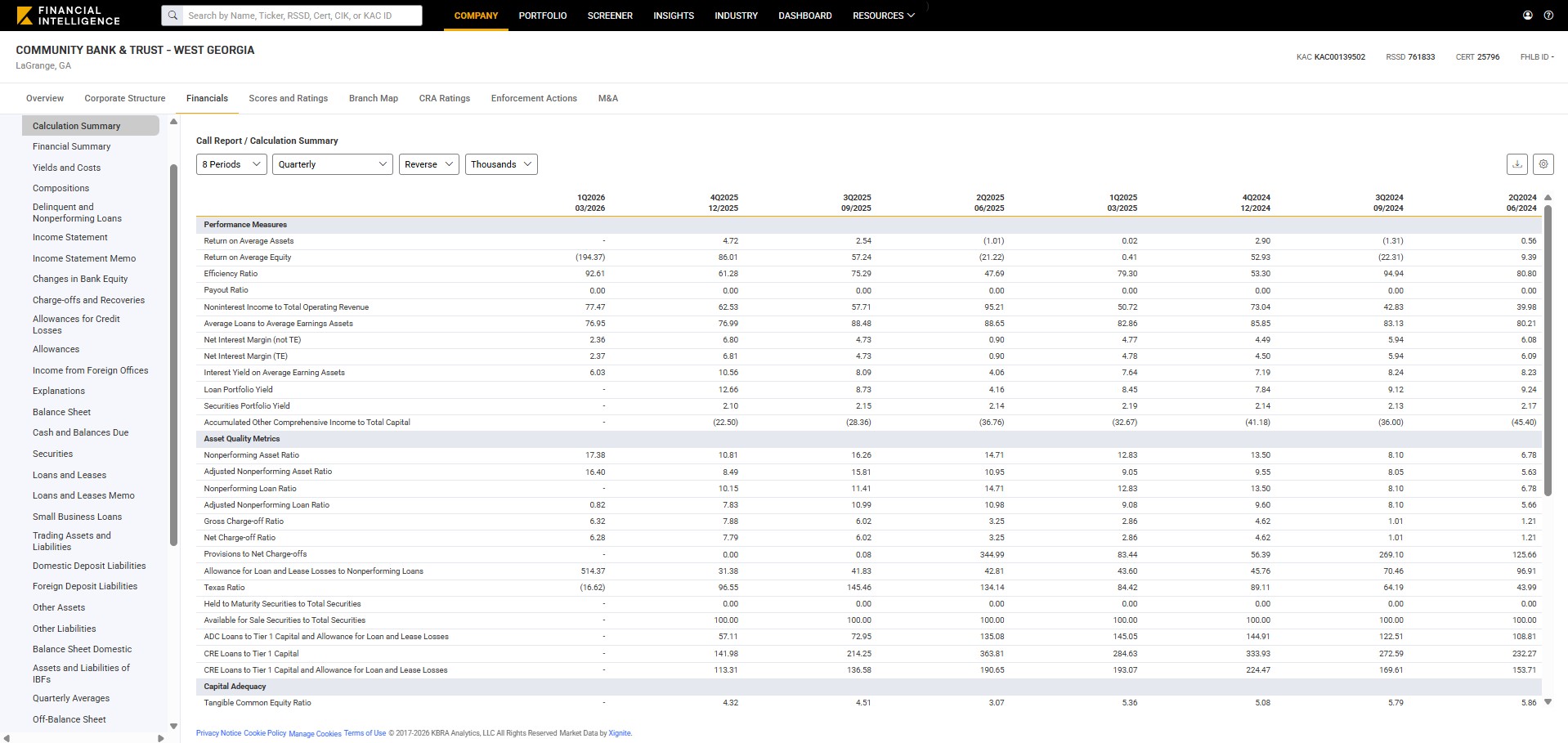
Since 3Q 2025, Community Bank & Trust – West Georgia maintained a KFI Score of E, correctly forecasting that the institution was likely to have financial problems. Further evidence supporting the score includes a January 12, 2026, FDIC consent order against the bank, wherein the bank was subject to supervisory restrictions and revisions to its board of directors, asset risk exposure, leverage ratios and other operational areas.
Call report data collected by KBRA Financial Intelligence (KFI) shows that at the end of fiscal year (FY) 2025, roughly 44% of the bank’s lending composition was concentrated within the commercial and industrial (C&I) sector. Over all four quarters, the bank charged off more than $5.8 million in C&I loans, pushing the net charge-off ratio to 7.79% in 4Q from 2.86% in 1Q.
The first bank failure of 2026 occurred in January, when the Chicago-based Metropolitan Capital Bank & Trust failed with $261 million in assets following problematic charge-offs in its C&I loan portfolio totaling $13.9 million. Roughly $251 million of the failed bank’s assets were acquired by First Independence Bank (KFI Score: B), based in Detroit.
Individual banks delinquency rates, charge-offs, and loan compositions can be viewed via KFI’s web app, as well as through our Excel add-in’s Loan Category and Delinquency Report template.
Over the last 16 years, 382 banks that failed were tracked and scored by KFI prior to closing. Of that total, 95% of banks that failed from 2010 through year-to-date (YTD) 2026 had a KFI Score of D or lower prior to the FDIC closure, according to KBRA Financial Intelligence (KFI) data, correctly predicting that the institutions were most likely in irreparably poor financial condition.
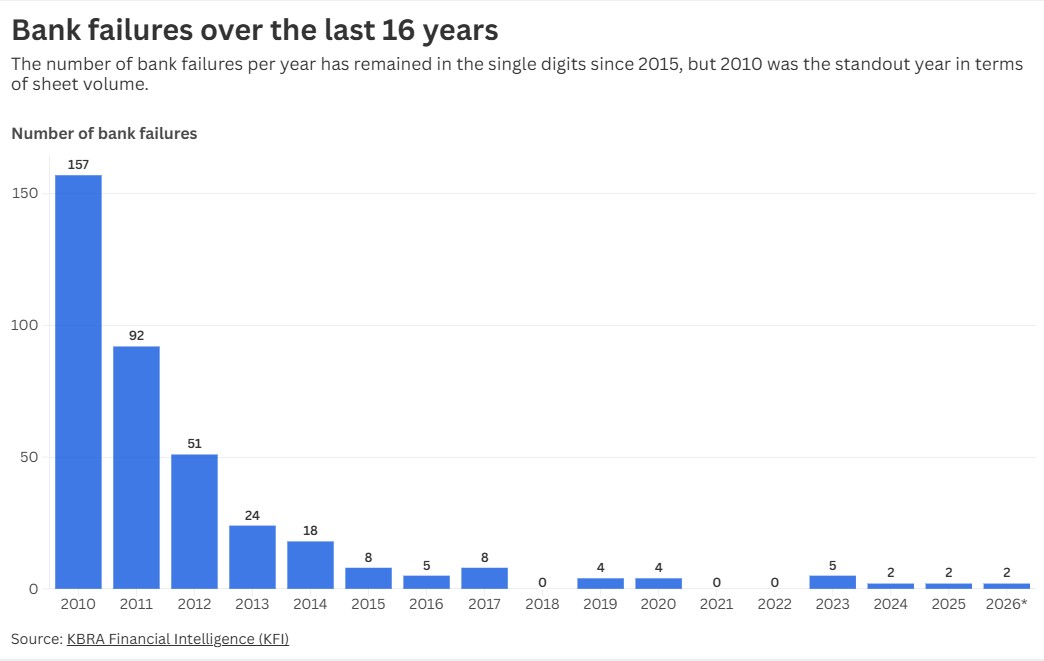
Looking at the data, there were 157 bank failures in 2010, the highest figure in the date range, followed by 51 failures in 2012, 24 failures in 2013, and 18 failures in 2014. Subsequently, bank failures have generally remained in the single-digit range.
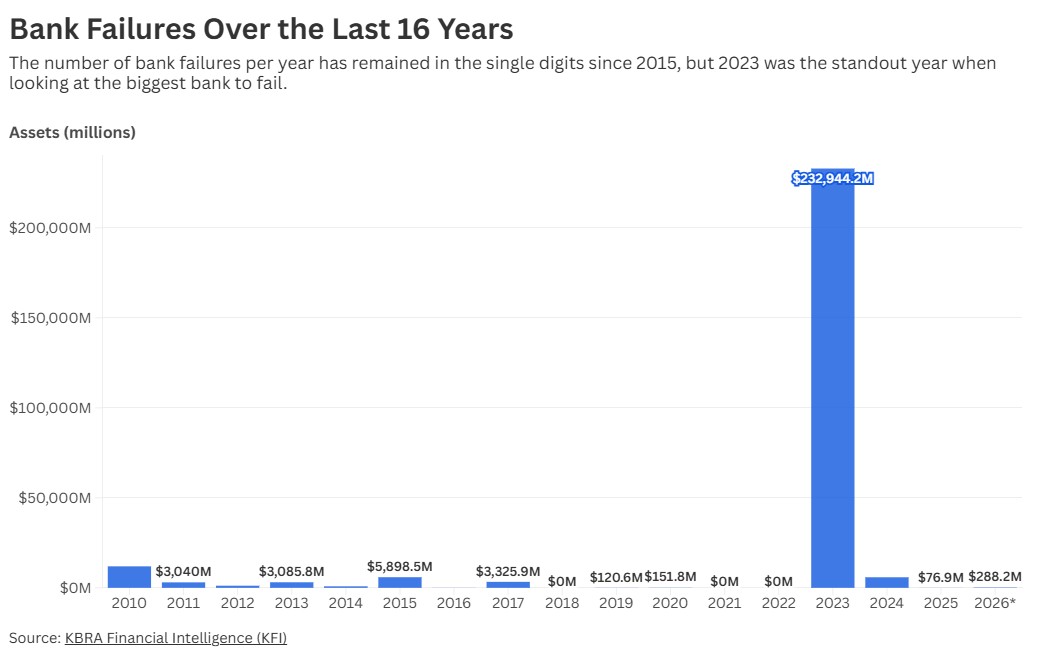
Despite only five failures in 2023, the collapses of First Republic Bank, Signature Bank, and Silicon Valley Bank—each with more than $100 billion in assets— made the year an outlier compared to other periods in the range. First Republic, with $232.9 billion in assets, was the largest failure of the year.
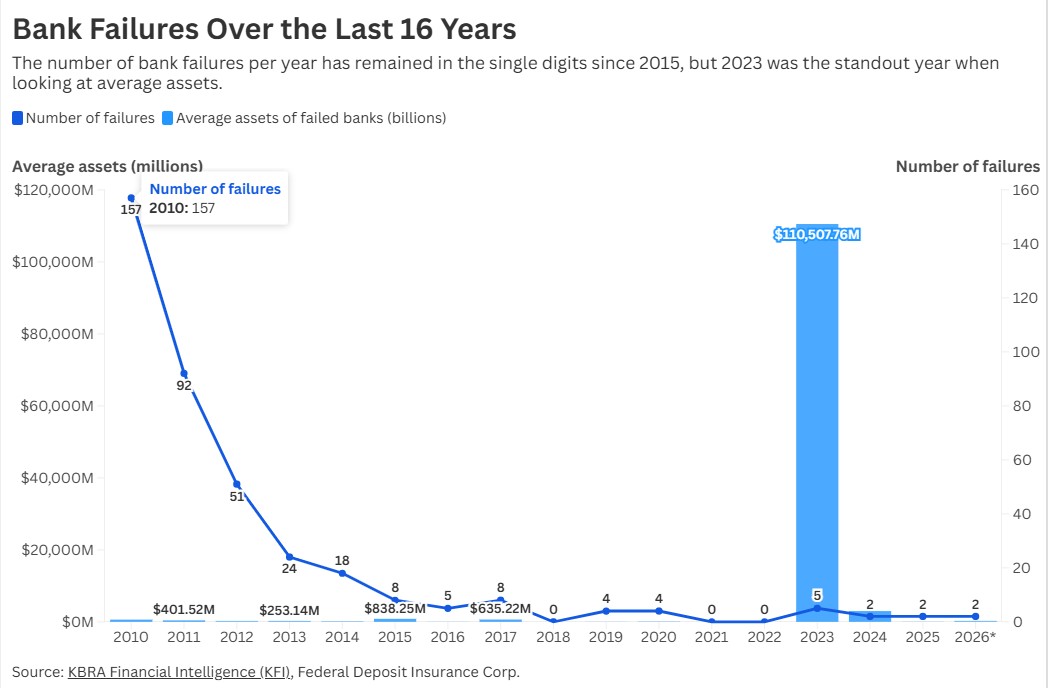
The same holds true when looking at the average total assets of failed banks per year. Despite 157 failures in 2010, the average for the year was only $614.7 million. By comparison, the average for 2023 was $110.5 billion.