
In His First Meeting as Federal Reserve Chairman, Kevin Warsh Sets a Different Tone from Powell
Jun 22, 2026, 12:00 PM GMT-4 | By Frank GarganoUpdate 07-10-26: Information about the leaders of each task force have been added.
As Kevin Warsh delivered his opening remarks during his first Federal Open Market Committee (FOMC) press conference, one theme remained constant above all others: “getting monetary policy right.”
“My colleagues and I are here to serve our legislative remit, which you’ve heard us say before—price stability and maximum employment—and these objectives guided our business in the meeting just concluded,” Warsh said.
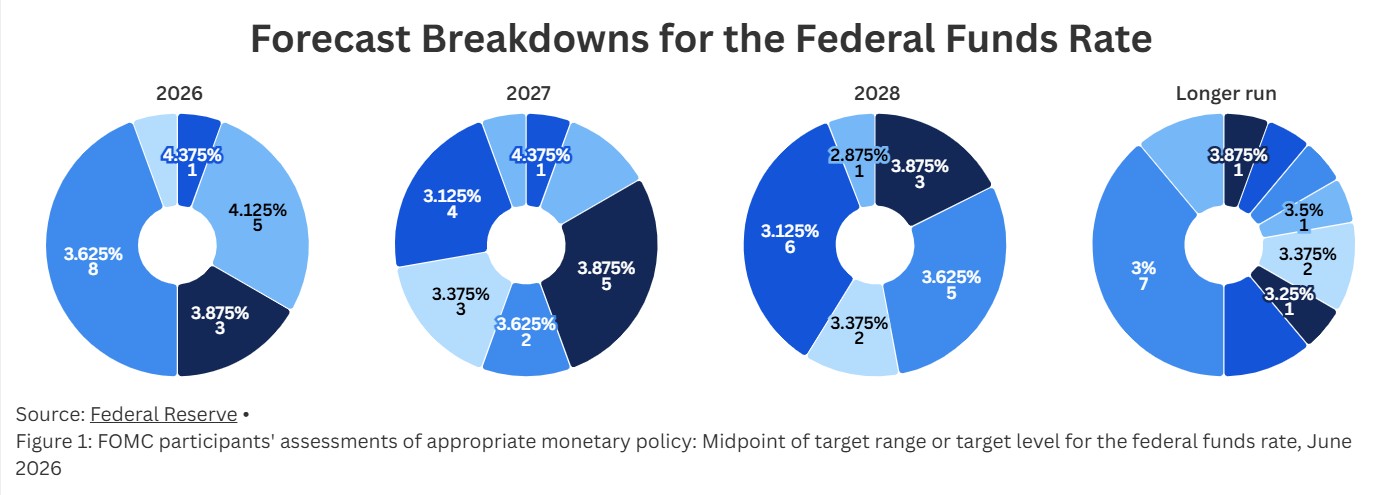
As many industry experts predicted, the FOMC unanimously agreed to keep the target range for the federal funds rate at 3.5%-3.75% in support of the Fed’s dual mandate. Data pulled from the Fed’s Summary of Economic Projections (SEP) shows that eight FOMC participants projected no change in the federal funds target range by year-end 2026, while nine predicted slight rises and only one projected a lower rate than the current target-range midpoint. Warsh was the only participant who declined to submit predictions for the dot plot.
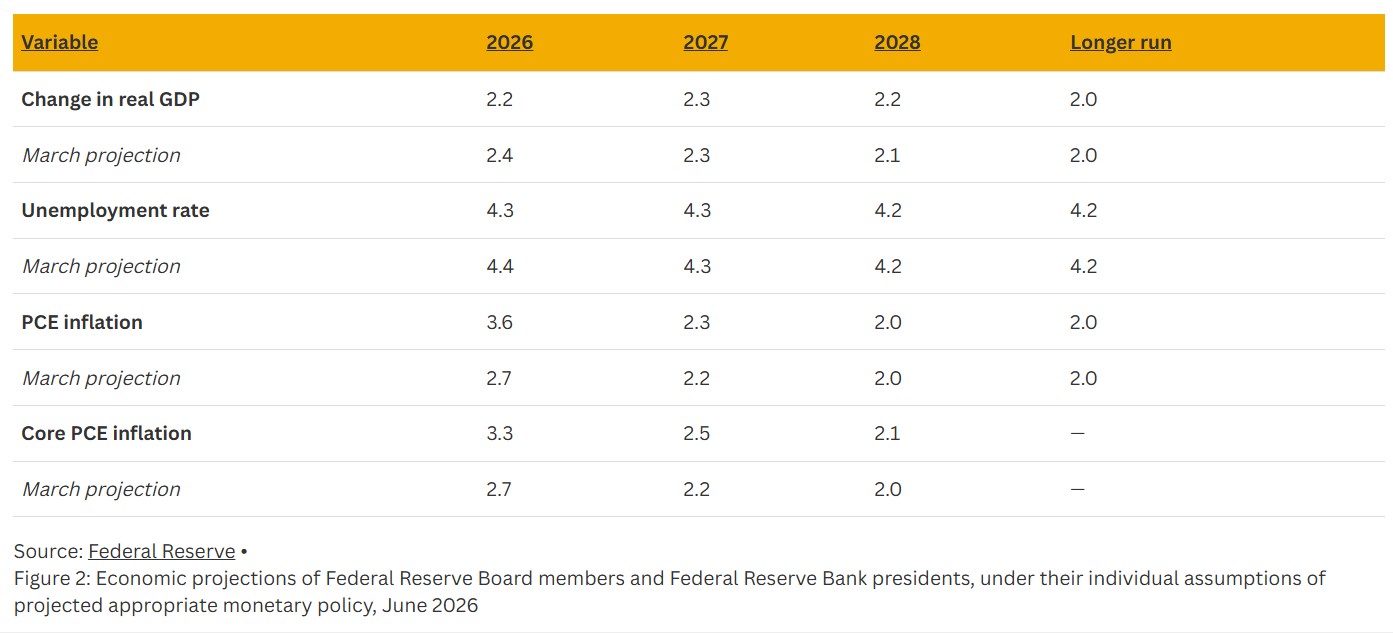
Forecasts for GDP were slightly lower than earlier March predictions, while figures for personal consumption expenditures (PCE) and core PCE inflation were noticeably higher across the same period. GDP is expected to grow 2.2% this year, down from 2.4% in March. PCE inflation is poised to hit 3.6%, up from 2.7%, and core PCE by 3.3% from 2.7%.
Warsh highlighted how inflation “has been running well ahead of the Fed’s long-stated inflation goal of 2% that’s been going on for more than five years.” He also remarked that “persistently high prices are a burden for the American people” and emphasized that the FOMC “will deliver price stability.”
Despite declining to issue any forecasts of his own, Warsh spoke at length about an initiative to establish five new tasks forces: communications, balance sheet policy, use and reliance on data sources, productivity and jobs, and inflation frameworks.
Below is a breakdown of each task force and its intended responsibilities.
Communications: Oversee possible improvements to the form and function of Fed communications, including its quarterly SEP.
Peter R. Fisher, professor of practice, Foster School of Business, University of Washington
Arminio Fraga, founder and chairman, Gávea Investimentos; former president, Central Bank of Brazil
Mervyn King, former governor, Bank of England
Balance sheet policy: Review the benefits and risks of the present ample reserves regime, as well as the composition of the Fed’s balance sheet, by reviewing alternative frameworks for the conduct and operation of monetary policy.
Karen Dynan, professor of economics, Harvard University
Raghuram Rajan, professor of finance, University of Chicago Booth School of Business; former governor, Reserve Bank of India
Jeremy Stein, professor of economics, Harvard University; former governor, Federal Reserve Board
Reliance on data sources: Evaluate new information sources and possible changes to methodology for improving data gathering as part of a broader effort to enrich data provided to policymakers.
Raj Chetty, professor of economics, Harvard University
Doug McMillon, former president and CEO, Walmart Inc.
Kevin Murphy, professor of economics, University of Chicago
Productivity and jobs: Conduct surveys on the overall market impact of new general-purpose technologies such as artificial intelligence (AI), while exploring how such technologies could help the Fed comply with employment and inflation mandates.
Marc Andreessen, cofounder and general partner, Andreessen Horowitz
Charles I. Jones, professor of economics, Stanford University, currently on leave at Anthropic
Asha Sharma, executive vice president and XBOX CEO, Microsoft Corp.
Inflation frameworks: Analyze the drivers of inflation, first principles, and various options for delivering on the mission of price stability in the current economy.
Greg Mankiw, professor of economics, Harvard University; former chairman, Council of Economic Advisers
Thomas Sargent, professor of economics, New York University; Nobel laureate
William White, senior fellow, C.D. Howe Institute; former economic adviser, Bank for International Settlements
Van Hesser, KBRA’s Chief Strategist, said in a June 18 interview with The Bond Buyer that efforts to tailor Fed communications have market players paying close attention to what the immediate and long-term impact will mean.
“Analysts and market participants like information,” Hesser said. “I understand the case to be made that you don’t want an abundance of information out there, which could sometimes put the FOMC theoretically in a box in terms of policy, but I think explaining rationales behind what the Fed does is important information that the market relies on.”
“I’d hate to see we go back to a time of much more limited information, as I don’t think that would be a positive,” he added.