
What Has M&A Activity Looked Like for Banks and Credit Unions in 2026?
Jul 15, 2026, 9:00 AM GMT-4 | By Frank GarganoUpdate 07-17-26: Additional deal information has been added and data visuals modified to reflect current figures.
The current spate of regulatory efforts to make mergers and acquisitions (M&A) between financial institutions easier, combined with global economic volatility, has left bank and credit union executives wondering what deal volume could look like for the remainder of 2026.
KBRA Financial Intelligence (KFI) now provides integrated M&A data throughout the platform, allowing users to research transactions across individual institutions while also monitoring broader industry activity. If you are interested in a live demonstration or have questions about these features, please reach out to the KFI team at [email protected].
As part of ongoing deregulation efforts, regulators at the National Credit Union Administration (NCUA) announced in an April proposal that they plan to remove and update guidelines for the process of merging an insured credit union into a bank.
The background of the proposal submitted to the Federal Register explains that 12 CFR part 708a, subpart C was established by the NCUA in December 2010 to institute “specific procedural and substantive requirements to protect the interests of credit union members during such mergers,” which include the “mandatory determination of the credit union's ‘merger value,’” as well as disclosure and voting requirements, according to the notice.
Proposed changes include removing the definition of “clear and conspicuous,” revising the requirement to publish notices of deals in newspapers, revising due diligence reporting requirements, and removing certain formatting requirements, plain-language determining factors, and “voting guidelines.”
“We are making great progress on NCUA’s Deregulation Project,” Kyle Hauptman, chairman of the NCUA, said in prepared remarks at the June NCUA board meeting. “Since we launched this effort, we’ve had 31 Notice of Proposed Rulemakings and received hundreds of comments from stakeholders. And this is just Phase 1.”
Industry experts like Paul Davis, founder of financial strategy and research firm Bank Slate Consulting and a banking expert, say that while M&A activity surged following the start of President Donald Trump’s second term, deal volume has cooled since March.
“Some of that is likely due to global uncertainty, though banker optimism over lighter regulatory burden is also playing a role,” Davis said. “Add to it that pricing hasn't hit a level that motivates the sellers who exist.”
Davis added that underlying pressures driving M&A deals, including “competition, tech investment, and succession,” have not gone away in the meantime, and that the markets should “see a pickup in activity if people believe the regulatory and legislative winds in Washington will change after the midterms.”
At the same time, the FDIC rescinded its 2024 Statement of Policy on Bank Merger Transactions and reverted to its pre-2024 Statement of Policy on Bank Merger Transactions because of concerns that the rescinded policy introduced too much uncertainty into the merger process.
“Based on these concerns, in March of 2025, the FDIC proposed a return to its historical approach by seeking comment on the reinstatement of the prior Bank Merger Statement of Policy, which is well understood by the public and market participants,” the notice in the Federal Register said.
Breaking Down the Numbers
Source: KBRA Financial Intelligence (KFI)
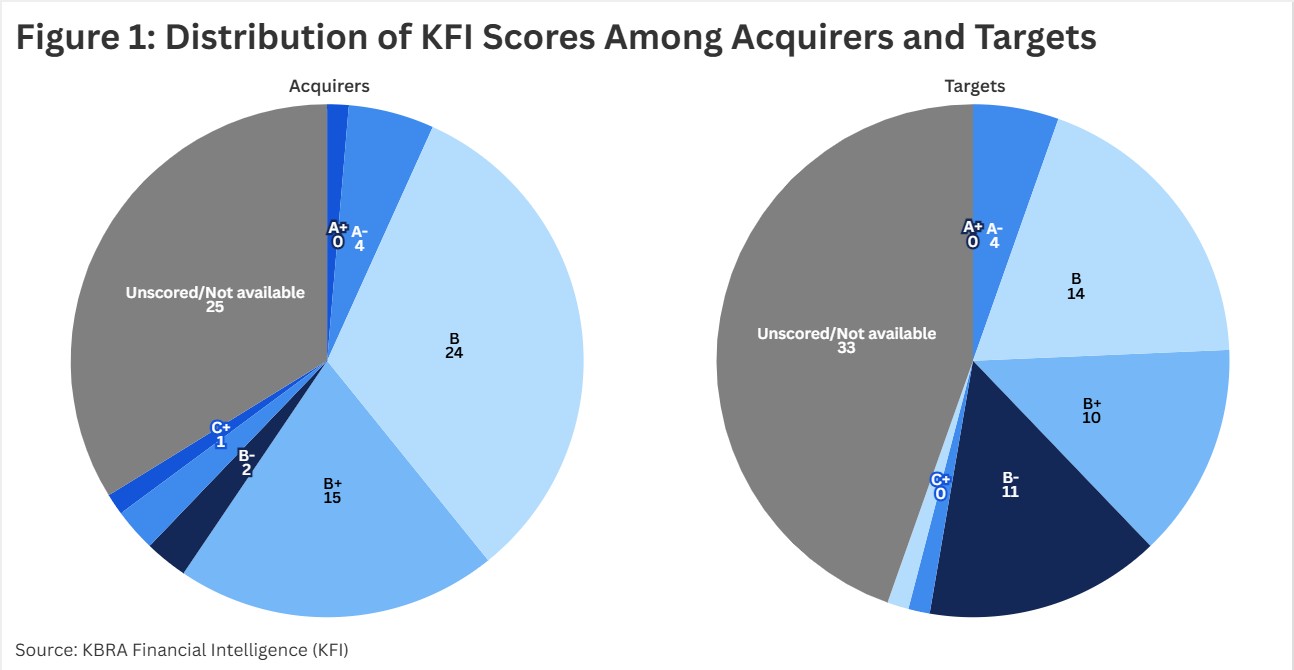
Of the 74 deals between financial institutions announced since the start of this year, the majority have involved acquirers and targets with a KFI Score of B- or greater.
Among acquirers, there was one with a score of A, four with a score of A-, 24 with a score of B, 15 with a score of B+, and two with a score of B-. Among targets, four had a score of A-, 13 had a score of B, 10 had a score of B+, and 11 had a score of B-.
KFI Scores are proprietary quarterly financial assessment scores that measure the financial health of all U.S. banks and credit unions on an A through E scale using Federal Financial Institutions Examination Council (FFIEC) and NCUA Call Report data. Our models incorporate various asset quality, capital adequacy, earnings performance, and liquidity and funding measures for managing counterparty risk and robust peer analysis.
Scores are based on the fiscal quarter reported prior to the announcement date of M&A deals.
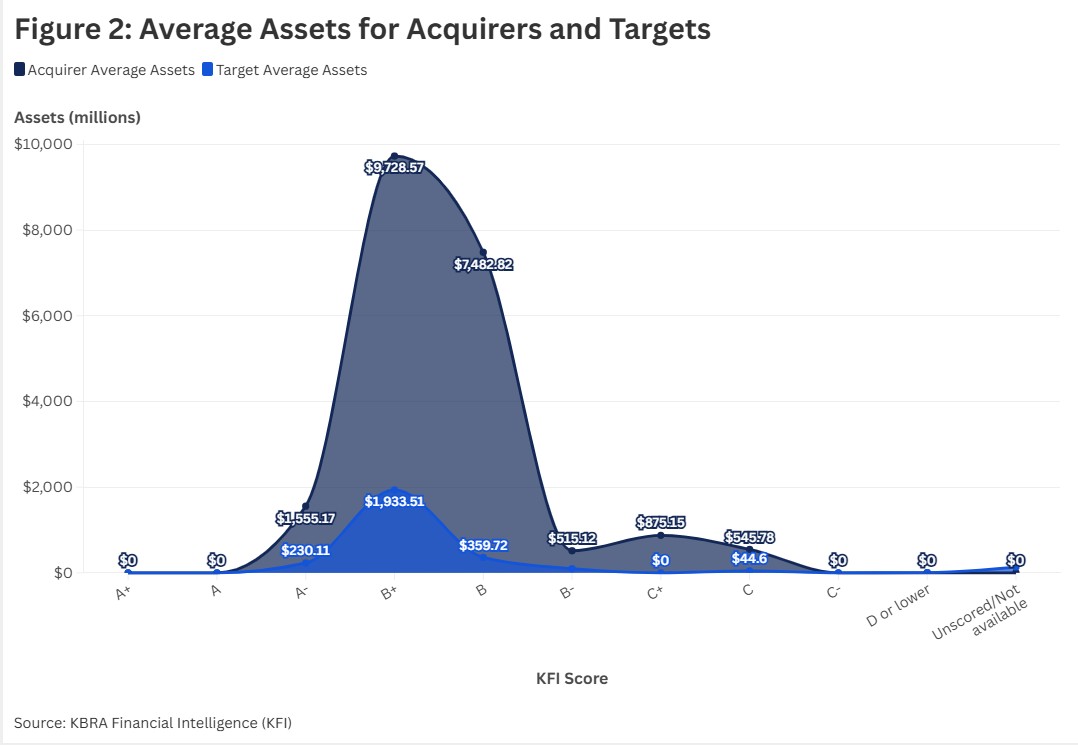
Source: KBRA Financial Intelligence (KFI)
Institutions with a B+ KFI Score had the largest average assets among both acquirers and targets, with acquirers averaging $9.7 billion per institution and targets averaging $1.8 billion per institution.
Source: KBRA Financial Intelligence (KFI)
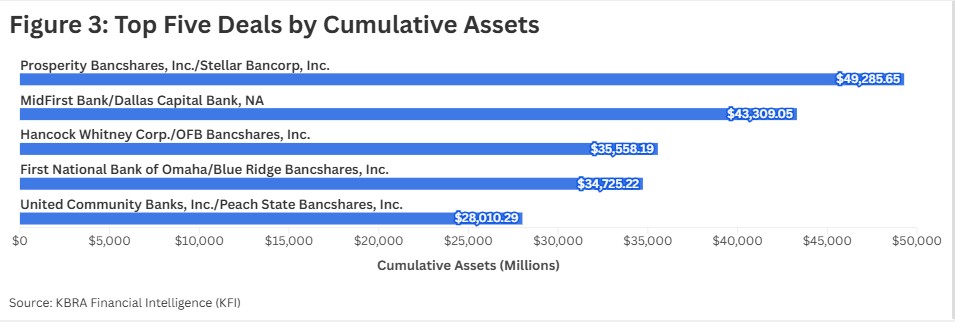
The biggest deal announced during the first six months of the year was between Prosperity Bancshares, Inc. (KFI Score: B+) and Stellar Bancorp, Inc. (KFI Score: B+), with the combined entity having roughly $49.3 billion of assets.
Close behind was MidFirst Bank (KFI Score: B) and Dallas Capital Bank, NA (KFI Score: B), with combined assets of $43.3 billion, followed by Hancock Whitney Corp. (KFI Score: B+) and OFB Bancshares, Inc. (KFI Score: Unscored), with combined assets of $35.6 billion, First National Bank of Omaha (Nebraska) (KFI Score: B) and Blue Ridge Bancshares, Inc. (Missouri) (KFI Score: Unscored), with combined assets of $34.7 billion, and finally, United Community Banks, Inc. (KFI Score: B+) and Peach State Bancshares, Inc. (KFI Score: Unscored), with combined assets of $28 billion.
To view the full list of deals for the first six months of the year, current KFI Clients can sign into the web application and navigate to User Guides. All others can sign up at the bottom of the page here to view the full list of deals.
Note: Commentary and opinions expressed by individuals who are not affiliated with KBRA Analytics do not necessarily reflect the views of KBRA Analytics, KBRA, or their employees. Such commentary is included solely to provide relevant industry perspectives.