
Breaking Down the ICBA’s Lawsuit Against the OCC
Oct 14, 2026, 12:00 AM GMT-4 | By Frank GarganoThe heightened volume of de novo bank charter applications in 2026 has ignited a lawsuit between the Independent Community Bankers of America (ICBA) and the Office of the Comptroller of the Currency (OCC), as the advocacy group seeks to challenge the agency’s authority in granting national trust bank charters to firms that conduct substantial non-fiduciary activities under a lighter regulatory environment compared to traditional banks.
In an October 2 press release accompanying the filing, ICBA President and Chief Executive Rebeca Romero Rainey highlighted the group’s stance that “the OCC's decision to allow companies to obtain national trust bank charters to conduct substantial non-fiduciary activities exceeds the authority Congress granted the agency.”
“Congress did not create the national trust charter as a side door into the banking system for crypto firms seeking the credibility of a federal bank charter without the Community Reinvestment Act (CRA) obligations, consolidated supervision, capital and liquidity standards, and FDIC insurance that apply to insured depository institutions,” she said. “Digital assets held at a crypto firm operating under a national trust charter do not carry those important safeguards.”
Overview of the Lawsuit
At the core of the lawsuit is the grievance with the OCC’s March 2 final rule related to Interpretive Letter No. 1176, which per the original notice sought to amend its rule related to chartering national banks in an effort to “clarify the longstanding authority of national banks limited to the operations of trust companies and activities related thereto to engage in non-fiduciary activities in addition to their fiduciary activities.”
The ICBA’s suit alleges that the OCC’s final rule and the letter assert powers to charter national trust banks that go beyond its authority under the National Bank Act (NBA). As such, the group is seeking to have the federal court declare both the letter and final rule unlawful and vacate them.
Cryptocurrency firms are the group considered especially problematic by the ICBA, as the lawsuit alleges that both the final rule and the interpretive letter “perversely allow entities engaged in highly risky cryptocurrency and digital assets activities” to enter the banking industry through “lightly regulated national charters.” This, in turn, purports to put community banks at a noticeable disadvantage against national players that can offer an expanded suite of consumer-facing products.
This relates to another part of the lawsuit. In February, the OCC granted a conditional approval of a national trust bank charter application by Protego Holdings Corp., a Seattle-based financial services firm focused on digital assets. The business lines planned on being offered by the subsidiary called National Digital Trust Company (NDTC) include digital asset custody, trading, lending, and other issuer services.
The ICBA claims that these services go beyond the OCC’s trust bank chartering authority under the NBA, such that the subsidiary bank would only offer digital asset-focused consumer products and not traditional deposit options. In the justification of its conditional approval, the OCC stated that “all of the Bank’s proposed activities are trust company operations or activities related thereto and are permissible for a national bank.”
Read more: The Top Banking Laws and Regulations Shaping the Industry in 1H 2026
What Has De Novo Charter Activity Looked Like in 2026?
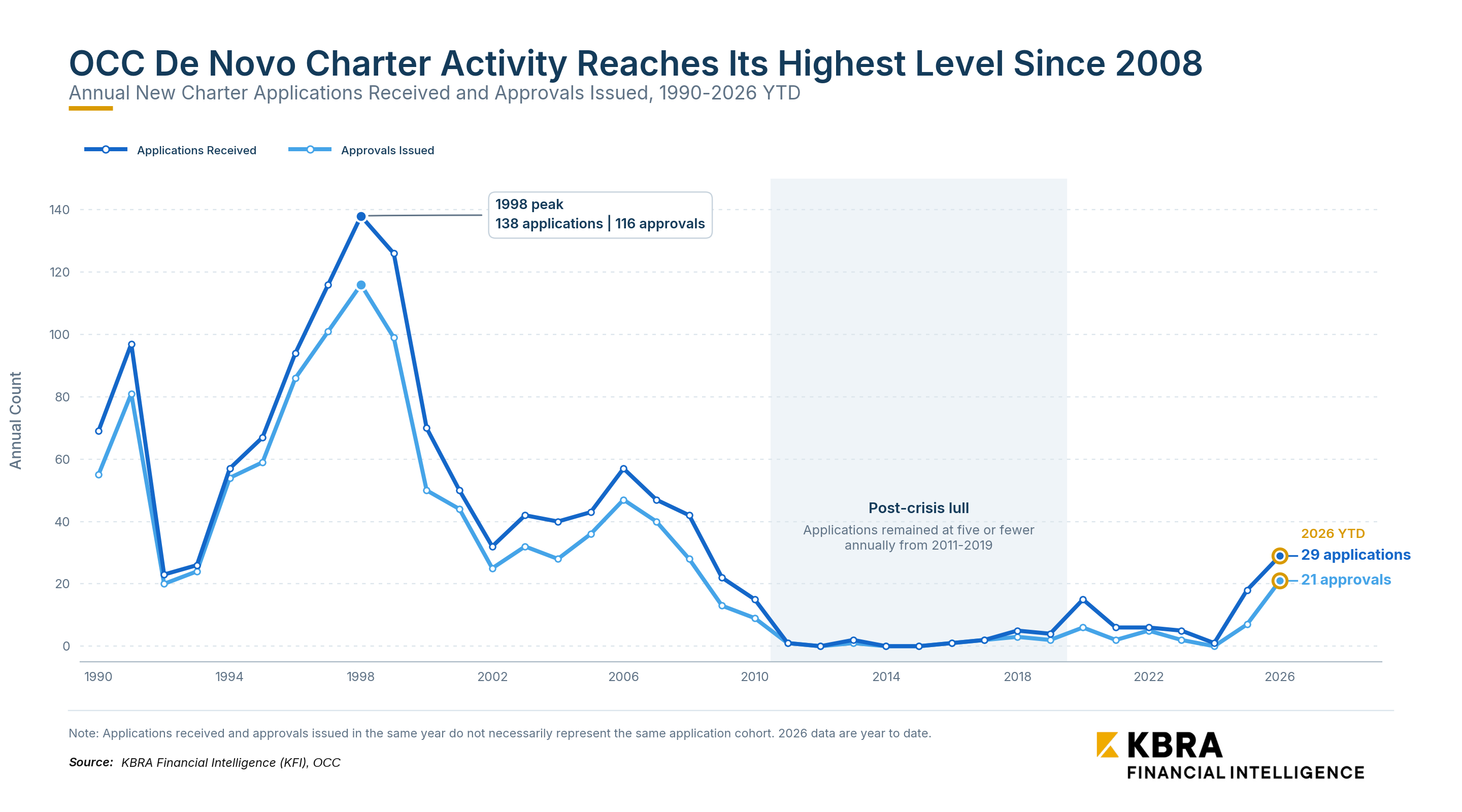
The OCC has received 29 de novo charter applications for the year so far, 20 of which are for national trust charters. Of the overall 21 applications approved in the same time frame, 12 were for national trust charters.
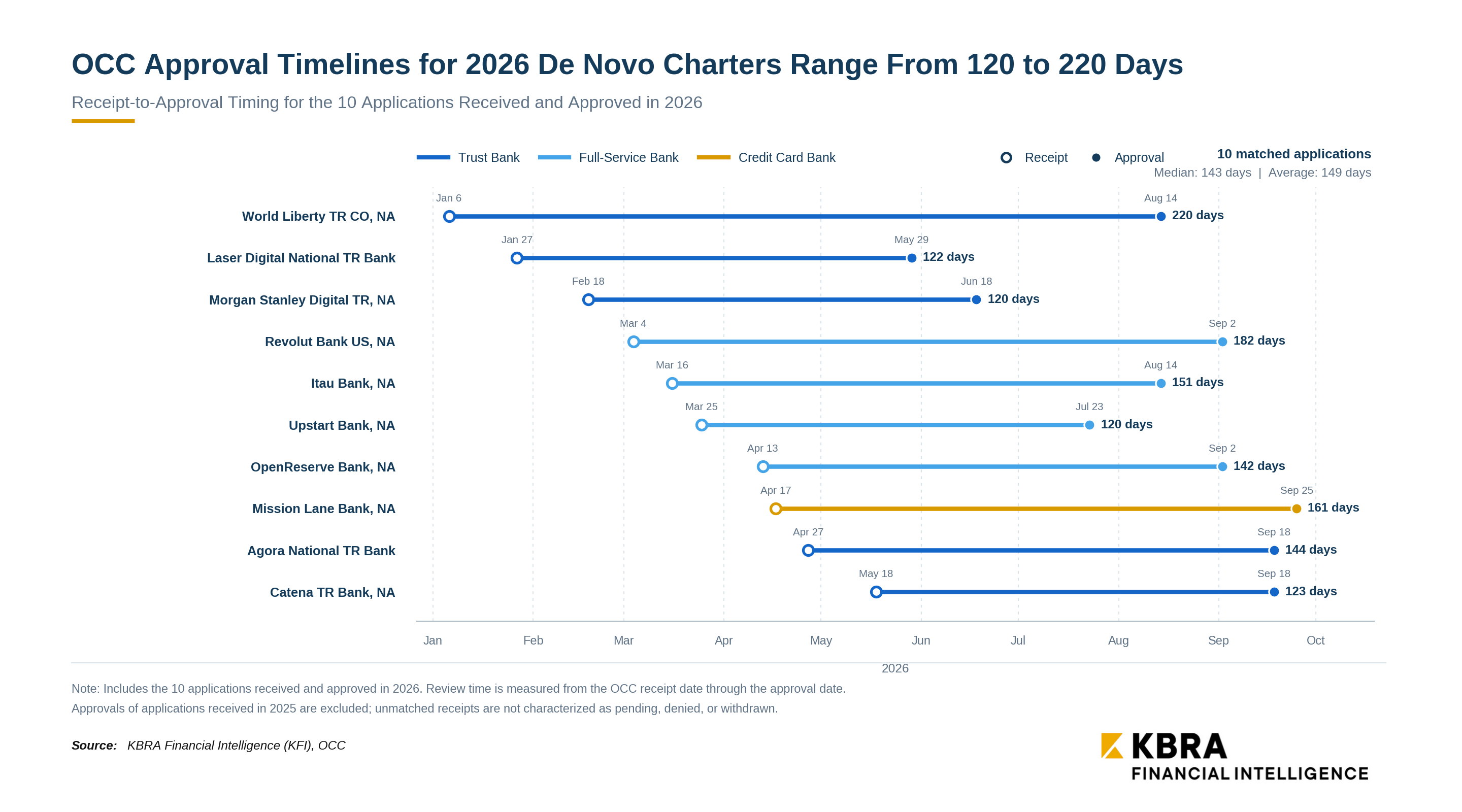
Between the year-to-date (YTD) lists of received and approved applications, there were 10 deals that were processed in 2026. The average processing time was 149 days, with World Liberty Trust Co. taking the longest at 220 and Upstart Bank, NA tied with Morgan Stanley Digital Trust, NA for the shortest at 120 days.
Where KFI Can Make a Difference
As de novo charter activity accelerates and the regulatory landscape continues to evolve, understanding the competitive environment is increasingly important for banks and credit unions. KBRA Financial Intelligence (KFI) provides financial data, performance analytics, and peer benchmarking tools covering nearly 9,000 financial institutions nationwide. KFI’s De Novo Score Assessment allows financial institutions to assess de novos while their regulatory submission process is still underway, providing a custom KFI De Novo Score before sufficient regulatory filing history exists to generate a standard KFI Score. The assessment combines available financial and pro forma information with KFI analyst review of factors including capitalization, liquidity and funding, asset quality, management, governance and other material risks.
This early assessment can support loan and depository relationship decisions before an official KFI Score is available, helping institutions evaluate prospective de novo counterparties earlier in their formation and operating lifecycle. KFI subsequently monitors the de novo's emerging regulatory history and evaluates its transition to standard quarterly KFI scoring after approximately one year of de novo coverage or sufficient regulatory filings, subject to KFI methodology and data sufficiency.
Contact customer support to request a KFI De Novo Score Assessment proposal.
Note: Commentary and opinions expressed by individuals who are not affiliated with KBRA Analytics do not necessarily reflect the views of KBRA Analytics, KBRA, or their employees. Such commentary is included solely to provide relevant industry perspectives.