
Federal Reserve Raises Interest Rates for the First Time in Three Years
Sep 16, 2026, 6:00 PM GMT-4 | By Frank GarganoMembers of the Federal Open Market Committee (FOMC) unanimously raised rates this month, with Federal Reserve Chairman Kevin Warsh concluding that while the policy action comes at a time “when the American economy appears to be strengthening” and “the labor side of the Fed’s congressional remit is in good shape,” inflation has been running above target for more than five years.
“Our predominant focus is on the price stability side of our mandate, as inflation has been too high for too long,” Warsh said during the September FOMC press conference on September 16.
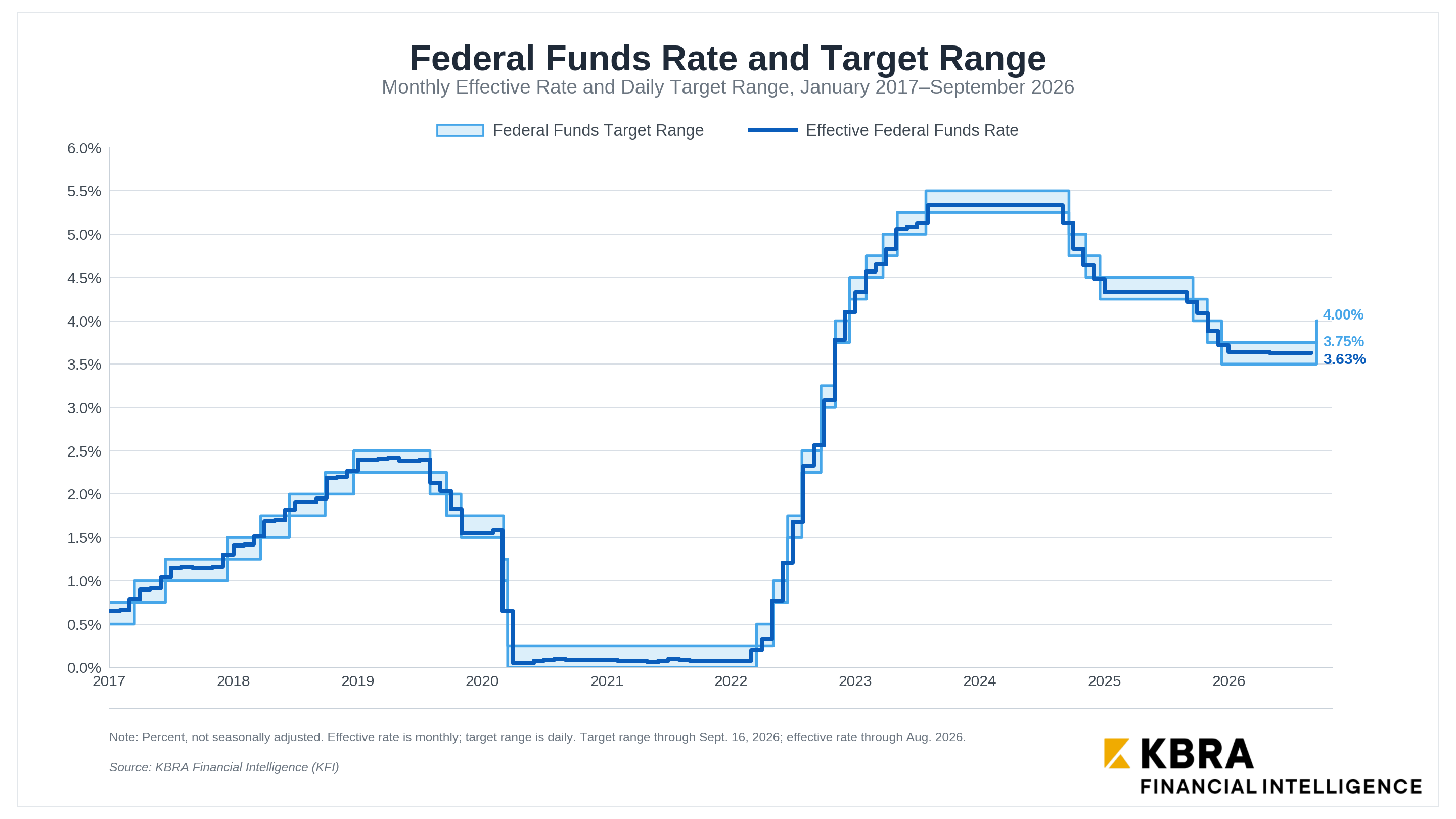
Members of the FOMC voted 12-0 unanimously to raise the target range for the federal funds rate by 25 basis points (bps) to 3.75%-4.0% in support of the Fed’s dual mandate, as “inflation remains elevated” and the Fed “policy action will support a timelier return to the Committee’s 2% goal,” according to a press release.
“While uncertainty remains elevated owing, in part, to geopolitical developments, domestic spending has been resilient,” the FOMC said. “Productivity growth is strong and capital investment is robust. Job gains have kept pace with the workforce, and the unemployment rate has changed little.”
The effective federal funds rate was 3.63% at the time of the announcement.
Economic projections from the FOMC released shortly before the press conference noted the following changes: Change in real GDP was up slightly to 2.3% from June’s 2.2% projection; Unemployment rate was down slightly to 4.1% from June’s 4.3%; PCE inflation was up slightly to 3.7% from June’s 3.6%; and Core PCE inflation was up slightly to 3.4% from June’s 3.3%.
Curious about where the Fed is heading next, and what could bankers expect to see? Register here for KFI’s Webinar “Decoding the Fed: What Today’s Policy Environment Means for Financial Institutions” on September 22, where American Banker Staff Reporter Kyle Campbell joins KFI to discuss policy decisions, task forces, and other changes at the Fed.
Market Performance by the Numbers
Inflation/Interest Rates
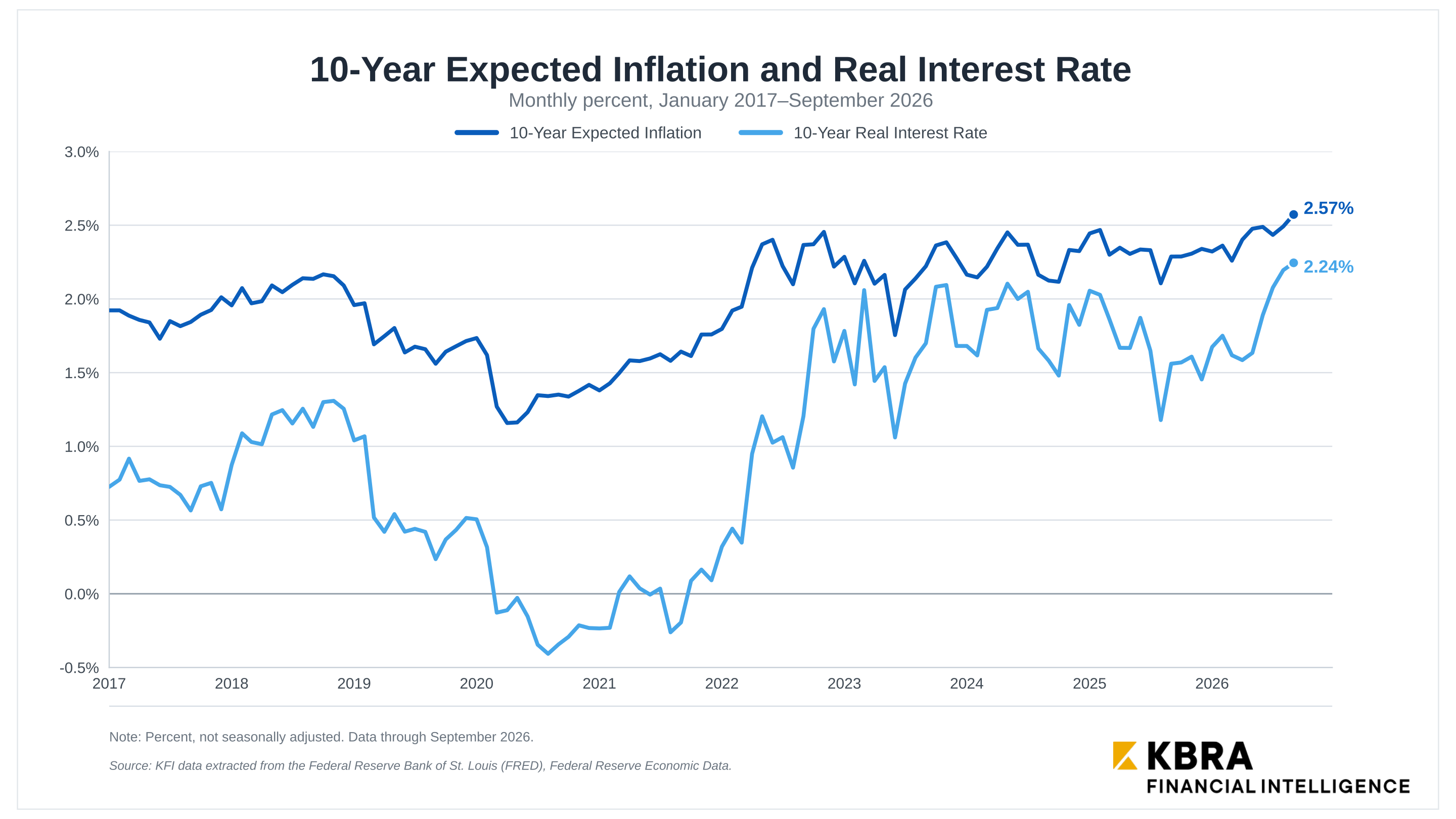
The 10-year Expected Inflation and Real Interest Rates were just under 2% and 1%, respectively, at the start of 2017, according to an KBRA Financial Intelligence (KFI) analysis of data from the Federal Reserve Bank of St. Louis.
The rate for both expected and real inflation were at their lowest points in the range during mid-2020, as economic shocks from the COVID-19 pandemic drove down consumer spending. The debut of President Donald Trump’s tariffs created upward pressure on inflation, which we see in the mid- to late-2025 period as both figures rise.
Warsh and other members of the FOMC have held rates steady hoping the elevated inflationary environment would equalize and start to ease. But as stated, the FOMC concluded that the standard for action that “underlying inflation is moving towards [the Fed’s 2%] objective clearly and at sufficient speed” was not satisfied.
“The committee’s unanimous vote shows our resolve to achieve price stability on a timelier basis,” Warsh said. “We aim to ensure that credit and financial conditions are consistent over time with our mandate. That relative price changes in some sectors of the economy do not broaden. That inflation compensation in market prices stays low.”
Treasury Yields
Warsh’s decision to pull back on issuing forward guidance, while not unheard of, created a bit of market shock, as well as introduced some pricing volatility.
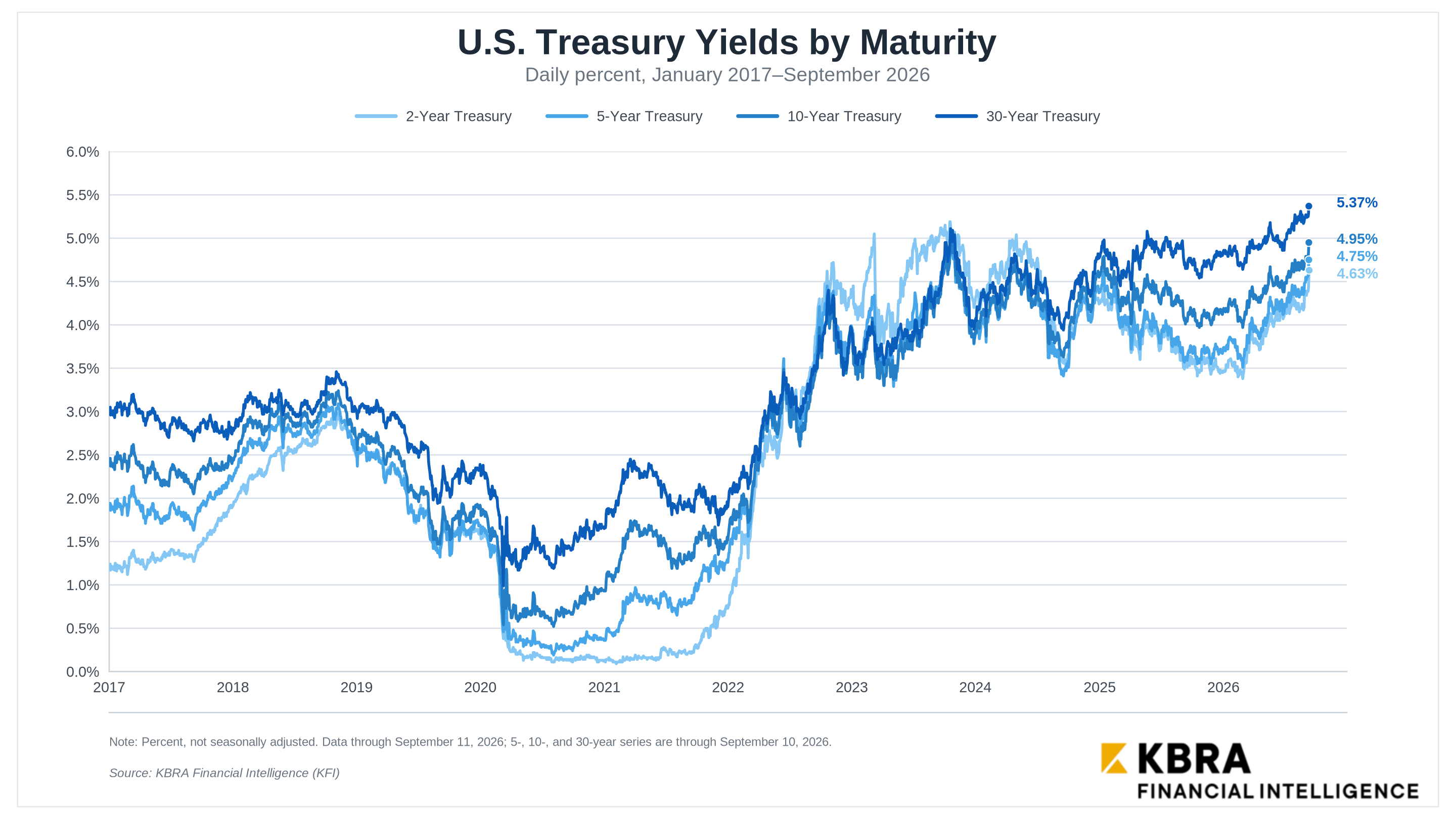
Since June, roughly one month after he took office as Fed Chairman, market yields quoted on an investment basis for 2-year, 5-year, 10-year, and 30-year notes have continued to trend upward.
Following Warsh’s recent commentary at the Jackson Hole Economic Symposium that the Fed has “work to do”, 2-year Treasury yields jumped 12 bps. “We must be confident that underlying inflation is moving to our objective, clearly and at sufficient speed,” Warsh said. “Otherwise, we have work to do. That’s our job . . . our mandate . . . and our charge to keep.
Personal Consumption Expenditures (PCE)/Core PCE
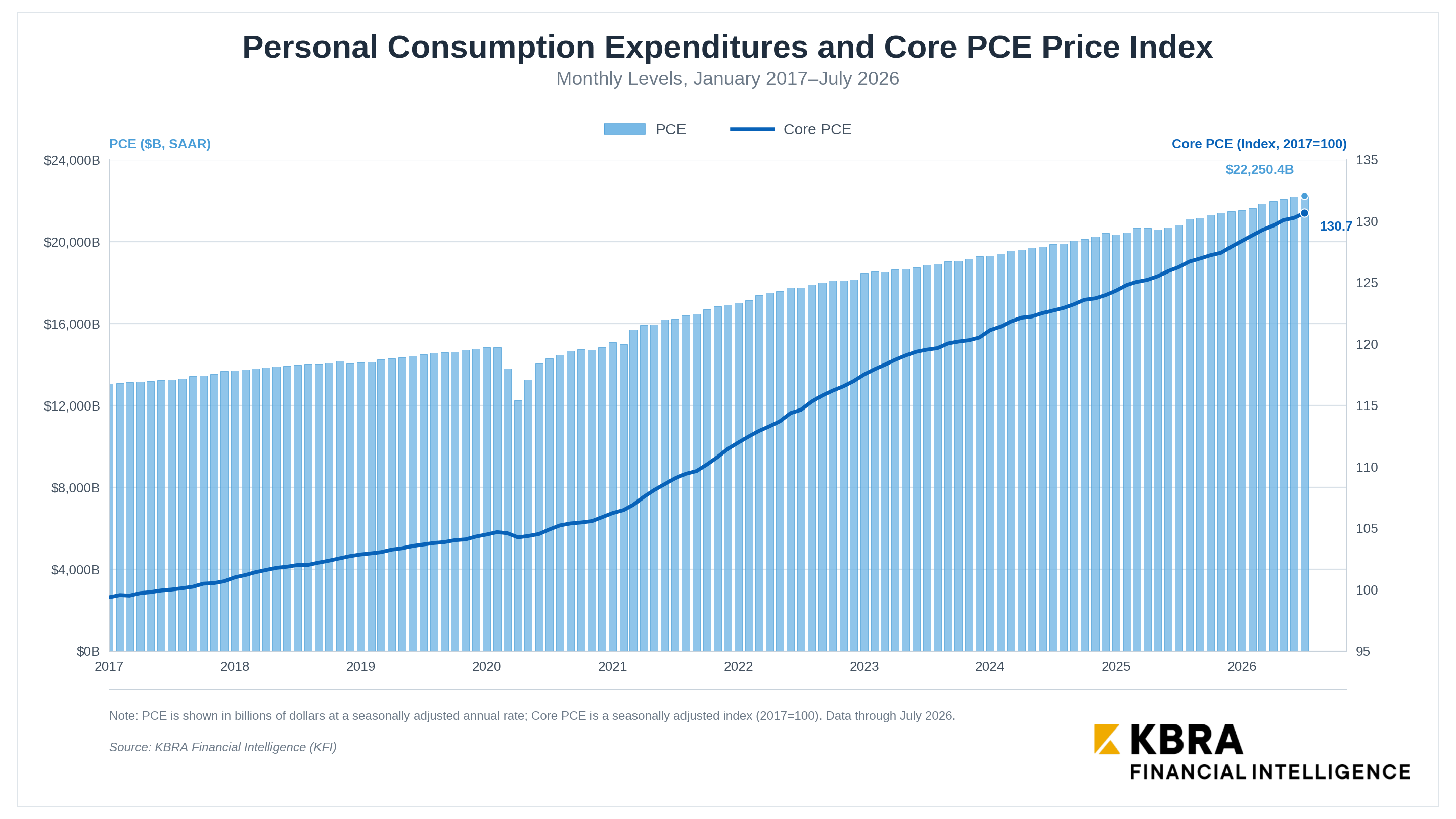
Overall, PCE has risen over the last 10 years, to $22.3 trillion in July 2026 from $13.1 trillion in early 2017. The COVID-19 pandemic created a notable drop in PCE due to lockdowns curtailing consumer spending behavior. Core PCE, which excludes food and energy, increased alongside consumer spending to 130.7 bps for July.
Note: Commentary and opinions expressed by individuals who are not affiliated with KBRA Analytics do not necessarily reflect the views of KBRA Analytics, KBRA, or their employees. Such commentary is included solely to provide relevant industry perspectives.