
Top Takeaways From the Fed’s Beige Book
Aug 06, 2026, 12:00 PM GMT-4 | By Frank Gargano
The Federal Reserve’s July Beige Book showed improved market performance, albeit with several constraining factors, including elevated fuel prices, deteriorating loan quality, and shrinking availability of skilled talent.
These factors and more have been a key focus for Fed Chairman Kevin Warsh. During a press conference following last month’s Federal Open Market Committee (FOMC) meeting, Warsh explained that discussions centered on high inflation and its intersection with the Fed’s core objective of delivering price stability.
“My colleagues and I considered the economic shocks of recent years. Strained supply chains arising from the pandemic, military conflicts, energy-supply disruptions, substantial increases in tariff rates and yes, the surge in A.I.-related investment,” Warsh said. “These differ in their sources—do they also differ in their effects on output and employment?”
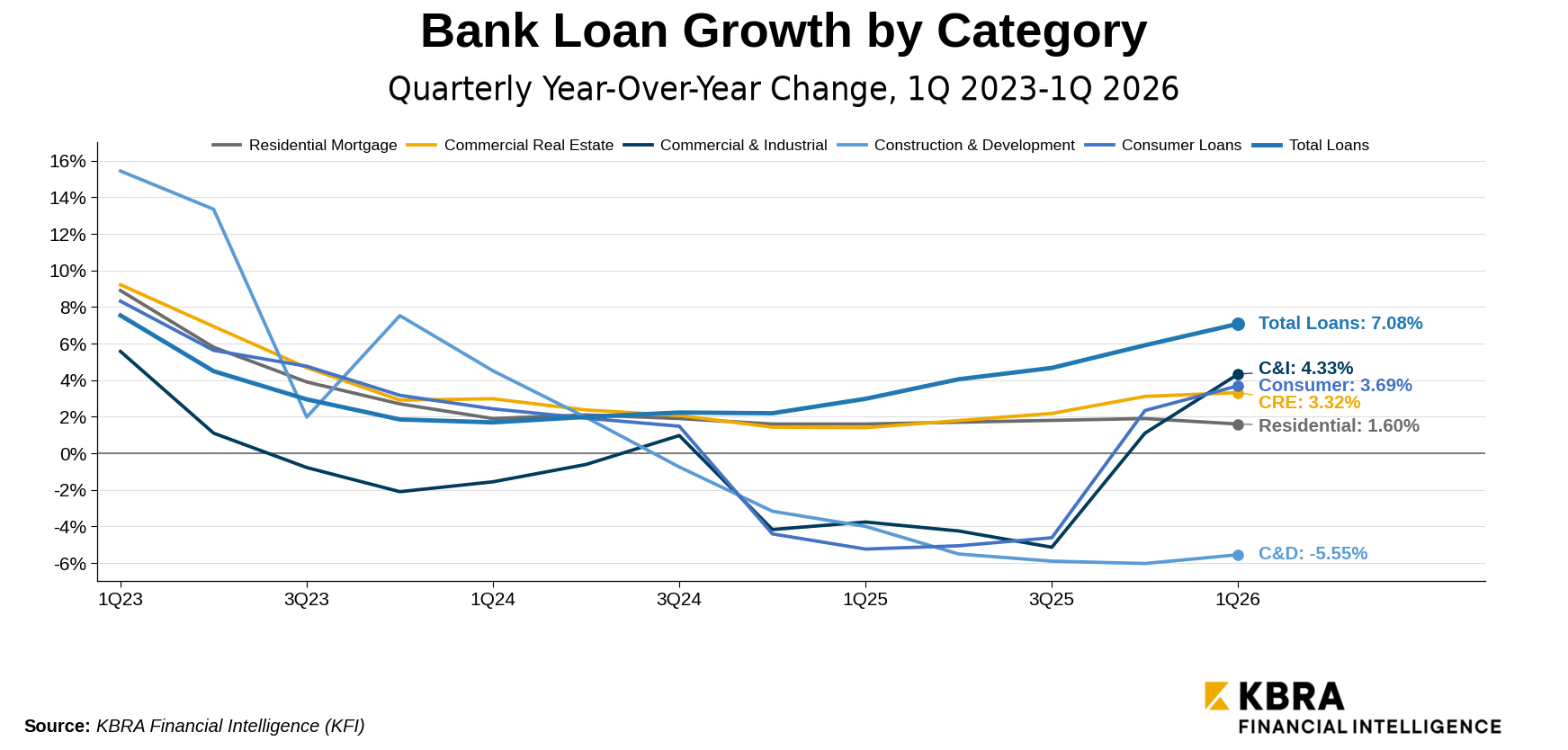
KBRA Financial Intelligence’s (KFI) analysis of the banking industry at large shows that total loans have continued to grow since 4Q 2024, while residential mortgage loans, commercial real estate (CRE) loans, and commercial and industrial (C&I) loans have largely followed suit in the same period.
Below, we summarize the latest Beige Book findings from each of the 12 regional Fed banks, highlighting the most important takeaways for bankers.
Market Segments at a Glance
Federal Reserve Bank of Boston
Summary of Economic Activity: Economic activity continued growing at a slight pace, while locally hosted World Cup matches drove consumer spending up modestly. Manufacturing and bank lending both saw similar growth, while real estate activity was mixed.
Labor Markets: Employment and wages were roughly unchanged overall. Increases in payroll and new hires in manufacturing, retail, and hospitality were muted against layoffs among apprentices in construction, as well as one instance of modest layoffs in services due to artificial intelligence (AI)-driven efficiency gains, according to the bank.
Prices: Output prices increased slightly on average. Construction prices saw modest rises due to continued increases in input costs, and manufacturers reported similar increases due to mounting cost pressures. Many financial firms expect to hold prices steady while hospital prices are predicted to increase slightly.
Consumer Spending: Consumer spending was up moderately over the last few months, largely due to World Cup-related gains in tourism and retail spending. Against this trend, the bank noted that households with “modest means” curtailed discretionary spending due to elevated necessities prices.
Financial Services: Bank loan volume and demand saw slight increases as credit standards remained unchanged. Loan pricing and nonperforming loans were stable, while one large financial services firm “reported flat revenues and profits and expected no major changes in activity going forward”, according to the bank.
Real Estate and Construction: Nonresidential leasing activity was mixed, with stable retail leasing, slight rises in office leasing, and reductions in industrial leasing. Residential and nonresidential construction eased while closed sales of residential properties decreased moderately in May versus the year-ago period.
Federal Reserve Bank of New York
Summary of Economic Activity: Economic activity experienced a modest upswing due to gains in manufacturing and employment, while input prices continued to grow due to increases in costs associated with fuel, freight, and other goods.
Labor Markets: Employment improved modestly as most sectors reported growing headcounts, particularly manufacturing, transportation, health, and others. Education reported employment declines. While wage growth remained modest, labor costs have become a growing concern among businesses in the district.
Prices: Selling price increases were at the high end of the moderate range, as input prices continued to see strong increases. Major drivers included fuel, freight, tariffs, metals, electronic components, and data center demand.
Consumer Spending: Spending saw moderate growth, with callouts in luxury items and consumer cooking products. Automotive sales tapered off after recent weakness, where new car sales flattened amid affordability concerns. High gas prices were also a concerning factor.
Financial Services: Activity saw modest growth overall across the broader finance sector. Business loan and residential mortgage demand was unchanged among small to midsize regional banks, while consumer loans, commercial mortgages, and refinancing all saw lower demand. Credit standards were constant for consumer loans and residential mortgages, but tighter for business loans and commercial mortgages.
Real Estate and Construction: Despite low housing inventory constricting sales activity, housing market activity saw slight increases. Demand was strong in upstate New York, while New York City’s low inventory and mortgage lock-ins led to an “underwhelming” market, per the bank.
Federal Reserve Bank of Philadelphia
Summary of Economic Activity: Economic activity rebounded from declines in the last period, with continual rises in manufacturing activity, recovery in nonmanufacturing activity, and moderate increases in tourism.
Labor Markets: Headcount reductions among nonmanufacturing firms and stagnating hiring rates at other firms drove slight but continual declines in employment. Wage growth was stable at a moderate pace, but the bank noted that industry contacts “reported little upward wage pressure” to change this pace beyond pre-pandemic levels.
Prices: Prices saw moderate rises for this period. Callouts for notable increases included plastic- or fertilizer-dependent products tied to Middle East-related disruptions as well as widespread fuel surcharges. Depending on the timeline of the conflict, contacts of the bank noted that fuel surcharges could ease while other material costs are prone to remain higher for longer.
Consumer Spending: Nonmanufacturing firms reported slight increases in sales activity following decreases from the last period. Nonauto retailers recorded little change in sales, while automotive retailers had steady sales, up from the moderate sales decreases last period, as affordability concerns continue to hamper activity. Tourism has continued to rise, with the most recent increase owing to both the World Cup and various America 250 events in the Philadelphia area.
Financial Services: Bank lending volume (not including credit cards) climbed modestly this period, improving from last period’s flatness and slight declines from the year-ago period. Commercial lending, industrial lending, and home mortgages were areas that district banks recorded moderate increases in. Home equity lines of credit (HELOC) and CRE lending were other areas of notable activity increases. Auto lending declined slightly.
Real Estate and Construction: Sales of existing homes declined slightly this period, showing signs of tapering after modest declines in the past period, which stemmed from limited supply leading to persistently higher home prices. New home sales were unchanged after modest declines last period, which contacts note matches an “overall low level of activity by historical standards”.
Federal Reserve Bank of Cleveland
Summary of Economic Activity: Business activity saw modest increases over the last few weeks, with regional players predicting moderate growth in the months ahead. Higher fuel costs constrained retail sales, while demand for manufactured goods continued to rise, albeit more slowly than in the prior period.
Labor Markets: Employment was up slightly from the prior period but varied noticeably by sector. Nonfinancial services and construction, respectively, reported modest and moderate increases in headcount, while businesses in the freight sector reported modest declines in the face of “softer demand, a need to protect operating margins, or uncertainty about overall economic conditions,” according to the bank. Wage pressures were moderate, with growth driven mostly by cost-of-living adjustments and merit increases.
Prices: Growth in nonlabor input costs was robust for the most recent period, primarily due to higher fuel costs. Other areas that saw cost increases included electricity, insurance, software, and food, albeit at a slower pace than in prior periods. Selling prices have also increased in recent weeks, similarly impacted by higher fuel costs but with the added impact of higher costs related to tariffs.
Consumer Spending: Consumer spending declined modestly in the most recent period, from a slight decline in the prior period. Once again, heightened fuel prices played a role in hamstringing spending activity, but the bank notes that retailers expect demand will trend upwards in the coming months.
Financial Services: Bankers reported modest growth in loan demand for the period, with commercial professionals highlighting increases in mergers, acquisitions, and capital expenditures since the last reporting period. The bank expects moderate increases in loan demand if household and business spending continues and if the Middle East conflict resolves, easing cost pressures.
Real Estate and Construction: Both residential construction and real estate activity saw robust increases for the recent period, as demand for affordable homes ticked up and luxury home demand remained strong. Bank contacts in nonresidential construction and real estate reported modest growth in demand, while CRE players said demand had remained stable or softened slightly.
Federal Reserve Bank of Richmond
Summary of Economic Activity: Economic activity saw moderate growth in the recent period, including residential real estate and manufacturing. Consumer spending experienced moderate growth, but the bank noted that spending concessions were made to some degree across income levels.
Labor Markets: Employment increased modestly for the recent period, despite reported understaffing challenges. As such, wages increased moderately, especially at firms in need of both attracting and retaining talent.
Prices: Price growth was moderate compared to the year-ago period, as the bank noted “service sector firms’ price growth dipped below three and a half percent year-over-year” while “non-labor input costs remained the same at above five and a half percent” across the same period.
Consumer Spending: Consumer spending recorded moderate growth this period, but fluctuations were apparent among buyers at all income levels consistent with tradeoffs.
Financial Services: Loan demand was up modestly among banks when looking at CRE portfolios and HELOCs, while consumer loan demand remained unchanged. Deposit balances held steady despite bank contacts reporting increased market competition.
Real Estate and Construction: Delays in the regular spring market did not deter moderate increases in residential real estate activity, while CRE activity was flat overall. Strong market segments included retail and higher-quality office spaces, while weaker areas featured industrial leases and lower-level office locations.
Federal Reserve Bank of Atlanta
Summary of Economic Activity: Economic activity experienced modest growth, balanced between increases in loan demand and consumer spending and decreases in employment and agricultural conditions.
Labor Markets: Employment levels flattened or slightly declined over the recent period as headcounts adjusted in the face of attrition and minimized role backfilling. Sectors such as health care and data center construction saw hiring trend upwards for growth or specialized skills. AI usage expanded across the industry, with specific applications for productivity, but bank contacts said they do not believe the technology will lead to layoffs in the near future. Wages increased modestly “in the two to three percent range,” per the bank, while pressures remained for in-demand or more technical positions.
Prices: Prices and nonlabor costs were up moderately, tied to persistently heightened fuel and transportation costs, as well as additional cost hikes stemming from the conflict in the Middle East. Commercial construction projects focused on emerging AI technologies have hampered supply and contributed to higher prices for steel, transformers, and other machinery.
Consumer Spending: Consumer spending expanded modestly, as higher-income households kept up with spending between periods despite signs of softening on the horizon. Lower-income households indicated financial stress, evidenced by lower spending, trading down, and reducing discretionary items. The World Cup boosted tourism activity in the district.
Financial Services: Loan growth ticked up modestly, driven mainly by consumer lending despite decreases in auto and credit card lending. Short-term buy now, pay later loans increased in the district, which the bank said evidenced persistent financial strain among households. Commercial and industrial lending declined.
Real Estate and Construction: Despite rising delistings, home sales saw modest improvement in the district as inventory growth moderated. Home prices were mainly flat, with few markets seeing homes sold above asking compared to other parts of the U.S. In CRE, the continual shift towards higher-value office space persisted as vacancy rates for Class A properties dropped into the single digits “for the first time since 2020,” according to the bank.
Federal Reserve Bank of Chicago
Summary of Economic Activity: Gains in manufacturing demand, employment, consumer spending, business spending, and other areas drove modest increases in economic activity for the district in the recent period.
Labor Markets: Employment saw modest growth over the recent period, with bank contacts characterizing the labor market as “stable” amid expectations for hiring to keep the same pace over the next 12 months. For manufacturing and other sectors, contacts reported hiring efforts consistent with prior periods, while one contact reported a decline in applicants compared to the year-ago period. Wages saw modest growth.
Prices: Prices saw moderate growth across May and June, fueling contacts’ expectations for this growth to continue across the next 12 months. Producer prices saw moderate growth, as did nonlabor input costs (on balance), with contacts attributing these increases to the conflict in the Middle East. Affected areas included “energy, shipping, and raw materials such as chemicals and plastics,” according to the bank.
Consumer Spending: Consumer spending saw slight increases for the period, with high energy prices impacting purchasing decisions. Nonauto retail sales ticked up slightly due to the scheduling of retail promotions, while automotive sales were strong. Hybrids saw strong demand from consumers, and used vehicle prices increased amid heightened demand and smaller inventories.
Financial Services: Business loan demand saw modest growth over the recent period, with small businesses recording greater volumes of loans. Consumer loan demand and quality were both relatively flat while rates ticked up slightly.
Real Estate and Construction: Demand for construction and real estate increased slightly for the period, while residential construction activity decreased slightly. Contractors and homebuilders surveyed by the bank stated that factors contributing to this trend included declining quoting activity, weaker backlogs, and underwhelming activity in May.
Federal Reserve Bank of St. Louis
Summary of Economic Activity: Economic activity for the district increased slightly for the last period, as employment remained unchanged while moderate wage growth persisted. Prices saw robust growth and increases were evident across the region.
Labor Markets: Employment levels remained largely the same between periods, as bank contacts employed lean staffing, contract workers, reduced hours, and limited full-time hiring to control costs. Wage growth was moderate.
Prices: Prices have seen robust growth in the recent period, with bank contacts highlighting cost increases in energy-infrastructure materials, insurance, transportation, and labor as prominent areas.
Consumer Spending: Consumer spending remained persistent since the prior period, as tourism and hospitality activity was flat overall. One bank contact, a social service nonprofit based in St. Louis, noted that declining purchasing power among consumers and scaled back benefits from the Supplemental Nutrition Assistance Program (SNAP) drove meal demand up “about 30% over the past two months.”
Financial Services: Banking activity was largely unchanged over the last two periods as loan demand was stable to slightly weaker depending on the market. The bank noted that commercial loans showed signs of improvement, but “loans to households with weaker credit continued to deteriorate, reflecting growing stress among borrowers without strong balance sheets,” according to the bank.
Real Estate and Construction: Residential real estate, CRE, and construction activity were all mixed for the last period. Bank contacts in construction provided varying responses, from “continued strength in warehouse construction” to local projects remaining in limbo due to “uncertainty, financing challenges, and a mismatch between lender underwriting standards and developer expectations.”
Federal Reserve Bank of Minneapolis
Summary of Economic Activity: Growth in employment, wages, and market areas such as construction and manufacturing drove economic activity to increase slightly, while other segments such as consumer spending and residential real estate remained flat between periods.
Labor Markets: Employment saw moderate gains since the prior reporting period, with employers in Minnesota and Wisconsin “reporting stronger labor demand than western District states.” Skilled labor was still in short supply. Wage growth ranged from modest to moderate, but evidence of softening persisted between periods.
Prices: Prices increased, albeit more slowly than they did in the prior period, while pressures on input prices remained heightened. In particular, bank contacts in the manufacturing sector reported persistently elevated prices of raw materials including metals and polymers. Retail fuel prices within the district decreased from the prior period.
Consumer Spending: Consumer spending activity remained unchanged from the prior period, with the bank noting that several contacts attributed the change in overall spending behavior to heightened gas prices. Contacts also noted that consumers are shifting more toward credit from cash and debit.
Financial Services: The Federal Reserve Bank of Minneapolis did not provide a standalone section for financial services, but did report that firms in “finance, insurance, and real estate reported better conditions than those in other service areas.”
Real Estate and Construction: Construction activity saw modest growth on balance from the prior period, with both overall employment and labor demand up due to what the bank attributed as “seasonality.” CRE saw slight growth across the same period, while residential real estate was mixed depending on the market.
Federal Reserve Bank of Kansas City
Summary of Economic Activity: Economic activity saw slight growth in the district from the prior period, as manufacturing activity continued to improve but inflation remained a headwind to profit margins.
Labor Markets: Employment increased slightly, as manufacturing anchored growth. Demand for part-time and temporary workers also increased to support the World Cup. Wage growth was modest from the prior period, with specific increases dependent on replaceability challenges.
Prices: Prices within the district saw moderate increases from the prior period, with contacts citing pressures from tariffs, volatility, and uncertainty in the energy market impacting profit margins. To counteract these pressures, many contacts reported “raising prices and investing in cost-saving technologies” as efforts to bolster margins.
Consumer Spending: Consumer spending was flat from the prior period. Modest declines in automotive and general retail spending were offset by continued growth in “travel, tourism, restaurants, and drinking establishments,” according to the bank.
Financial Services: Loan demand and credit standards among banks in the district were largely unchanged from the prior period, but moderate growth in demand for residential mortgage loans was noted. Overall loan quality remained unchanged for the most part, but some bank contacts reported modest deterioration in CRE portfolios.
Real Estate and Construction: CRE contacts reported that “capital flows supporting property sales and other transaction activity” saw moderate growth. However, credit lines for the development of new properties became more difficult to access.
Federal Reserve Bank of Dallas
Summary of Economic Activity: Growth in banking, energy, and nonfinancial sectors drove growth in economic activity from the prior period.
Labor Markets: Employment activity had solid growth from the prior period, even as the bank noted that an aging workforce and reluctance among workers to change roles hampered talent attraction. This dynamic was particularly evident among data center developers and oilfield service firms. Wage growth was stronger.
Prices: Higher fuel and freight costs drove price pressures up for the period, with bank contacts noting that raw material price increases were driven by supply chain issues tied to “trade policy and to the Middle East conflict.”
Consumer Spending: Retail sales saw growth from the prior period, while auto sales dropped in June. The policy agreement to reopen the Strait of Hormuz, leading to a decrease in gas prices, strengthened forecasts.
Financial Services: Loan volume and demand saw notable growth in June, as virtually all loan categories saw volume increases, except consumer loans, which remained stable. Credit standards and terms grew tighter while loan pricing remained stable.
Real Estate and Construction: Housing activity was subdued amid slow sales activity, builders offering discounts, and mortgage rate buydowns, clouding the outlook. Building activity was also mixed, as office, apartment, and retail construction was constricted, but data center and industrial construction were strong. CRE activity expanded.
Federal Reserve Bank of San Francisco
Summary of Economic Activity: Economic activity was stable from the prior period but somewhat muted, as stable employment and manufacturing growth were offset by declines in retail sales and consumer spending.
Labor Markets: Employment was largely unchanged from the prior period, as companies opted to maintain headcounts. As seen in other districts, attracting skilled talent remained a challenge for firms, particularly those in the Mountain West and Hawaii regions, according to the bank. Wages grew slightly, with bank contacts reporting adjustments matching historical averages.
Prices: Prices saw moderate growth for the period, with “elevated energy costs elevating transportation and freight expenses” across various sectors, according to the bank. Metals and electronic components were among a host of tariff-impacted goods that reportedly suffered cost pressures, including others such as fertilizer, petrochemicals, and animal protein.
Consumer Spending: Retail spending ticked down from the prior period, with the bank citing stable demand for groceries but weakened demand for specialty discretionary items. One Southern California bank contact reported that in-person shoppers were both shifting away from more expensive food options and shrinking the volume of ordered items. Some markets experienced overall slowdowns in spending on leisure, restaurants, and hotels.
Financial Services: Financial services remained stable from the prior period. Demand for both commercial and industrial loans experienced modest growth and credit quality was mostly sound. Auto lending activity trended downward and mortgage activity remained muted between periods, per the bank.
Real Estate and Construction: Residential real estate activity was largely stable from the prior period, with solid demand for single-family homes weighed down by growing mortgage rates. Heightened asking prices on properties and smaller inventory subdued home sales across California. CRE demand was mixed across the state, but construction activity remained solid for projects with adequate funding.
Note: Commentary and opinions expressed by individuals who are not affiliated with KBRA Analytics do not necessarily reflect the views of KBRA Analytics, KBRA, or their employees. Such commentary is included solely to provide relevant industry perspectives.