
Will the FDIC’s Revised Deposit Insurance Protocols Help Stem the Flow of Bank Closures?
Aug 27, 2026, 12:00 PM GMT-4 | By Frank GarganoThe FDIC announced a new two-phase process for reviewing deposit insurance applications this month, as the agency seeks to “encourage new bank formation, accelerate the speed of the review process, and improve the efficiency of the application process,” per the August 10 press release.
“Improving the de novo process and encouraging more new bank formation has been a key priority for the FDIC,” said Travis Hill, chairman of the FDIC, in the release. “Today’s action is one of several steps the FDIC has been working on in furtherance of this goal. A healthy pipeline of new entrants is critical to the long-term vitality of the banking sector, particularly for community banks.”
The implementation of the updated review procedure was driven by the passage of the 21st Century ROAD to Housing Act, which included provisions that directed agencies like the FDIC to both review the de novo application process and reduce friction points within.
Breaking Down the Numbers
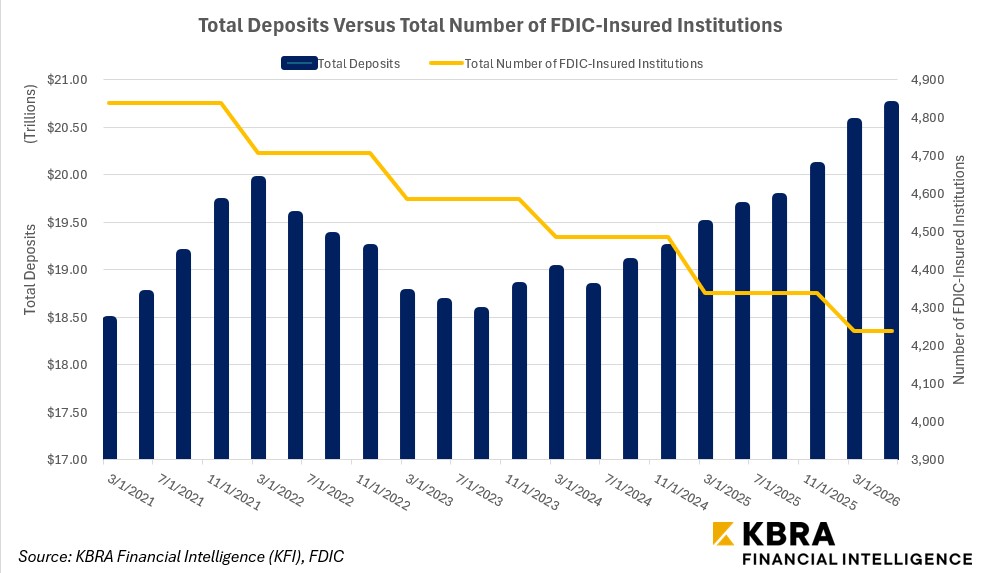
The number of FDIC-insured institutions—both commercial banks and savings institutions—has continued to decline over time due to failures and consolidation.
From 2021 to 2025, only 42 new institutions have been chartered while nine have failed for the same time period, according to the FDIC’s quarterly banking profile for the second quarter. KBRA Financial Intelligence (KFI) data shows more than 4,200 banks are active for the year so far, down from more than 4,800 in 2021.
Highlighting the period from 4Q 2024 to 2Q 2026, charters have continued to decline while total bank deposits have notably grown to $20.7 trillion from $19.2 trillion in 2024. Total assets for the most recent quarter exceeded $26.5 million.
Individual bank performance, charge-offs, and deposit and loan compositions can be viewed via KFI’s web app and Excel add-in tool. Request a free trial of the KFI platform or sample template here.
What Is Changing for De Novo Institutions?
Under the FDIC’s new process, the 120-day time frame begins upon receipt of the deposit insurance application, and assessment of the submission ultimately kicks off phase one.
The first 30 days of phase one involve the FDIC reviewing the application for completeness and communicating with the applicants if more information is needed.
After the application is considered substantially complete, the FDIC shifts to the next step involving management interviews, resolution of information requests, and analytical reviews of business plans, financial projections, and other metrics of the proposed institution, all with the target of issuing contingent approval for deposit insurance within the time frame.
Notably, the new process allows for a contingent approval earlier in the timeline than the previous process, which granted such approval toward the end. This allows de novo organizers to begin building out tentative institutions sooner than before.
After contingent approval is granted, applicants can begin work on fulfilling the conditions set forth by the FDIC before a final approval for deposit insurance is granted. This can take generally up to 12 months to accomplish.
Ultimately, final approval before an institution is open for business lies with the relevant chartering authority, such as the Office of the Comptroller of the Currency for national banks and state authorities for regional institutions.
Data from the FDIC shows that for the 12-month period ending July 31, applications considered substantially complete took 117 days on average for processing, three days shy of the 120-day goal set by the new framework. Of the 17 submitted for the period, 11 were approved within the time frame.
KFI’s De Novo Score Assessment allows financial institutions to assess de novos while their regulatory submission process is still underway, providing a custom KFI De Novo Score before sufficient regulatory filing history exists to generate a standard KFI Score. The assessment combines available financial and pro forma information with KFI analyst review of factors including capitalization, liquidity and funding, asset quality, management, governance and other material risks.
This early assessment can support loan and depository relationship decisions before an official KFI Score is available, helping institutions evaluate prospective de novo counterparties earlier in their formation and operating lifecycle. KFI subsequently monitors the de novo's emerging regulatory history and evaluates its transition to standard quarterly KFI scoring after approximately one year of de novo coverage or sufficient regulatory filings, subject to KFI methodology and data sufficiency.
Contact customer support to request a KFI De Novo Score Assessment proposal.
Note: Commentary and opinions expressed by individuals who are not affiliated with KBRA Analytics do not necessarily reflect the views of KBRA Analytics, KBRA, or their employees. Such commentary is included solely to provide relevant industry perspectives.