
Will the Federal Reserve’s Rate Hike Derail Bank Funding Cost Gains?
Nov 04, 2026, 11:00 AM GMT-5 | By Frank GarganoThe Federal Reserve’s decision to raise interest rates for the first time in more than three years, coupled with last month’s rate hold, could undo a beneficial trend for U.S. banks that have enjoyed steadily declining funding and deposit costs over the past two years.
The central bank voted to raise the target range for the federal funds rate by 25 basis points (bps) in September to 3.75%-4.0%, as persistently elevated inflation remained too big of a problem for members of the Federal Open Market Committee (FOMC) to leave unaddressed. “Our predominant focus is on the price stability side of our mandate, as inflation has been too high for too long,” said Fed Chairman Kevin Warsh during the September FOMC press conference on September 16.
Now, in the wake of the October decision to hold rates steady and murmurs of a second rate hike before the end of the year, banking leaders are wondering whether funding costs could start climbing once again.
To better understand the historical context behind these trends and how the banking industry is positioned to handle the current interest rate environment, KBRA Financial Intelligence (KFI) examined trends in deposit costs, funding expenses, and net interest margins (NIM) among U.S. banks from 1Q 2022 through 2Q 2026.
Industry by the Numbers
Funding and Deposit Costs
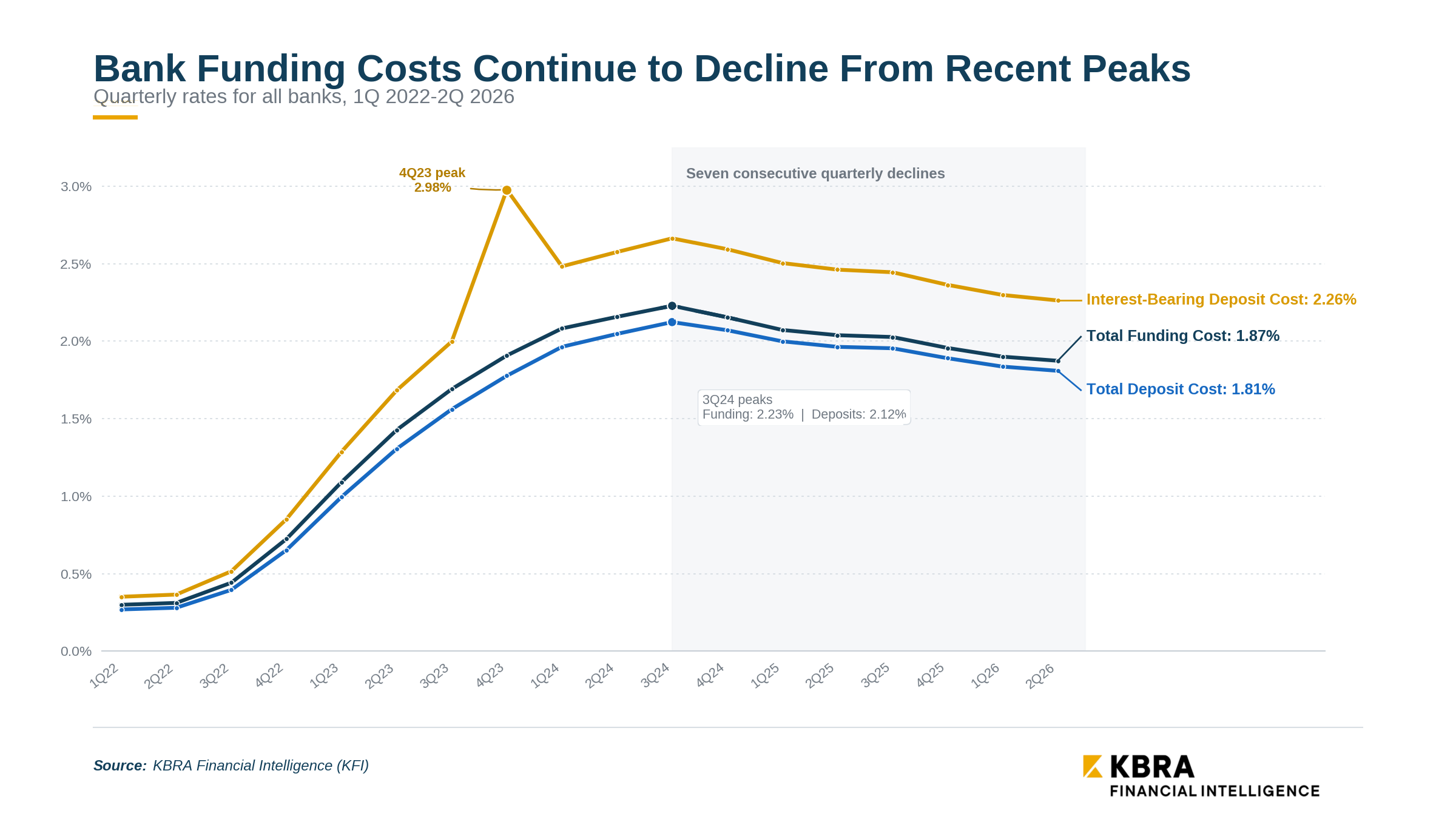
While costs tied to funding and deposits have steadily declined since their peaks in 3Q 2024, they are still far above their early 2022 levels when the Fed began its campaign of aggressively tightening interest rates.
Data from KFI shows that the average cost of total funding fell 36 bps to 1.87% for 2Q 2026, from the period high of 2.23% in 3Q 2024. Average cost of total deposits dropped 31 bps across the same period to 1.81% from the 3Q 2024 high of 2.12%. Average cost of interest-bearing deposits reached its peak in 4Q 2023 at 2.98% but fell the following quarter before rising once again to 2.66% in 3Q 2024. From there, the cost of interest-bearing deposits fell 40 bps to 2.26% in 2Q 2026.
Despite the relief banks have seen through easing deposit costs, the Fed’s 25-bp rate hike in September and consequent rate stay in October stand to reintroduce funding pressures and competition in the marketplace. Such competition among banks to retain or even grow deposits—especially the more consumer-enticing interest-bearing deposits—could see funding costs rise again.
NIM
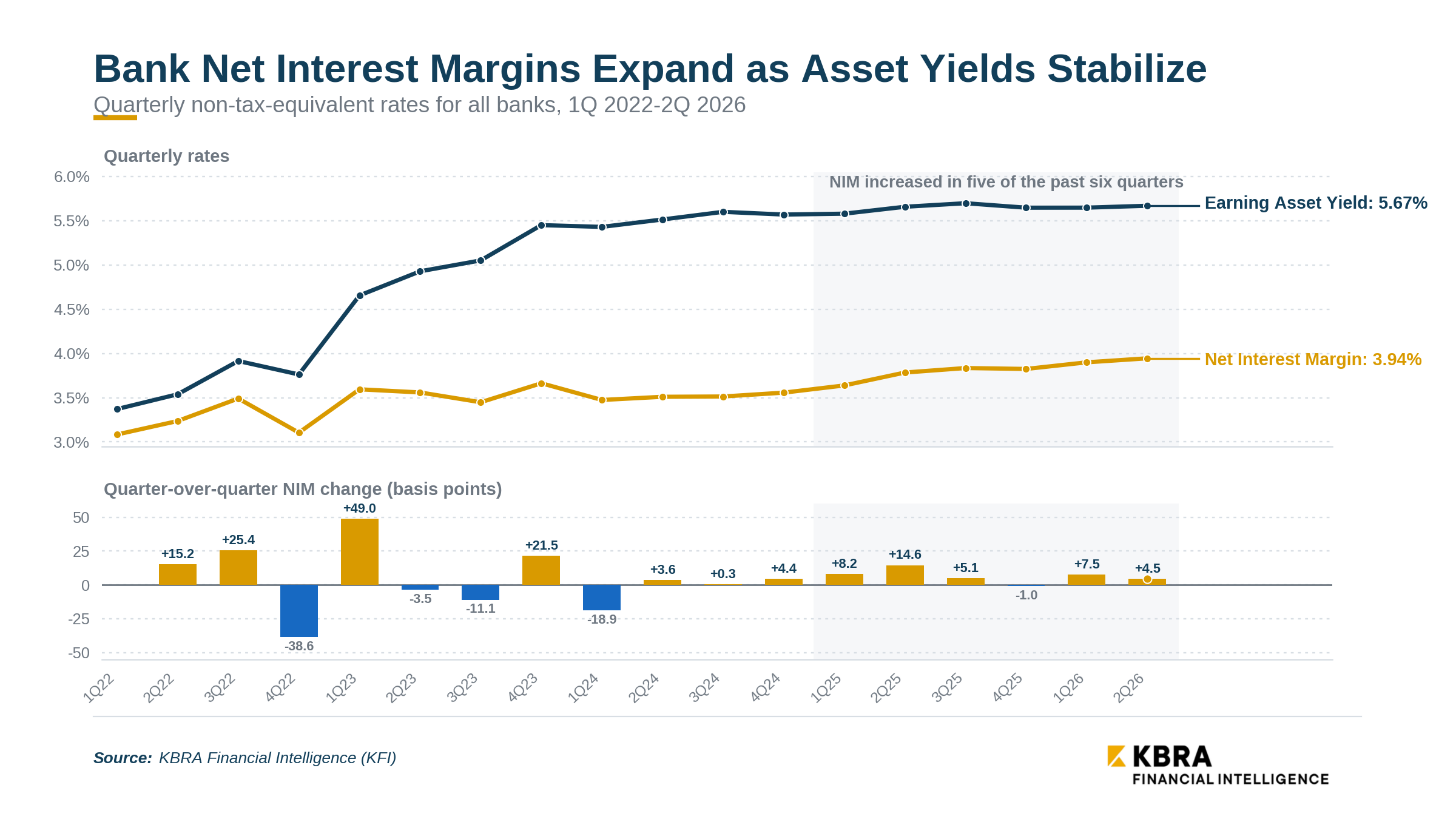
Improvements in NIM for banks in five of the last six quarters hint at declining funding costs being a positive influence on bank profitability as opposed to primarily relying on strong performance from interest-earning assets.
Average NIM increased to 3.94% in 2Q 2026 from 3.51% in 3Q 2024, a 43-bp improvement, while earning-asset yields increased only modestly over the same period to 5.67% in 2Q 2026 from 5.60% in 3Q 2024.
Higher interest rates following the Fed’s rate hike could possibly have a mixed impact on banks depending on their exposure to certain assets. Those with floating rate loans and assets able to reprice in a short period of time would benefit from higher rates, while those allocated toward interest-bearing deposits would face renewed pressures.
Non-Interest-Bearing Deposits
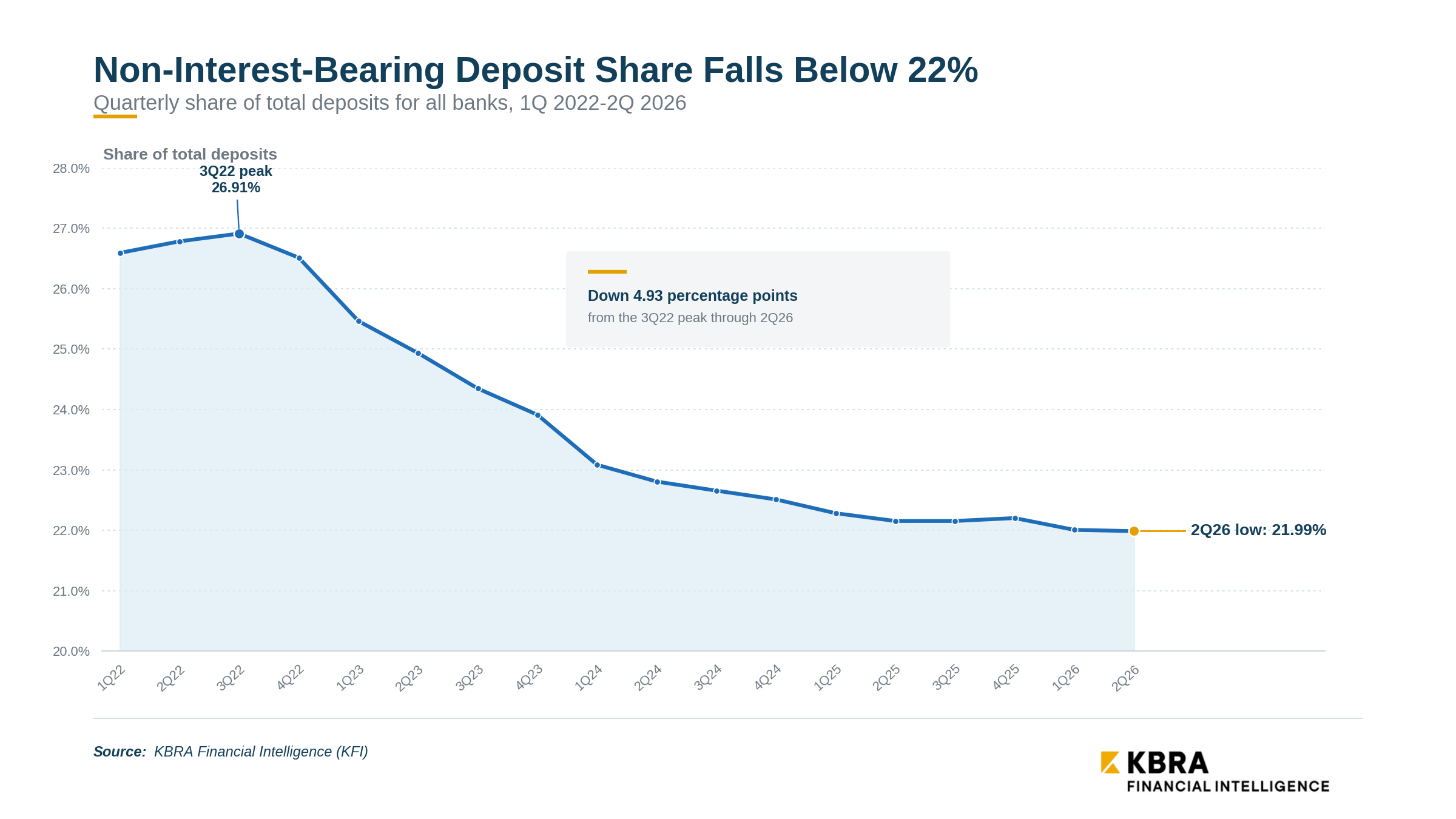
Shares of non-interest-bearing deposits as a percentage of total deposits peaked in 3Q 2022 for banks at 26.91% but have noticeably fallen since then to 21.99% in 2Q 2026, a drop of roughly 5%.
This class of deposits is especially valuable for banks, as funds carrying no direct interest expense are prime for fueling the creation of loans and other interest-earning assets without the obligation to depositors. Shifts away from these deposits toward interest-bearing accounts due to market competition stand to increase funding costs and squeeze NIM, as banks with higher balances of non-interest-bearing deposits are vulnerable to repricing pressures.
Note: Commentary and opinions expressed by individuals who are not affiliated with KBRA Analytics do not necessarily reflect the views of KBRA Analytics, KBRA, or their employees. Such commentary is included solely to provide relevant industry perspectives.
Stay informed with KFI Insights
Get the latest research and analysis on banking industry trends, financial data, and developments impacting U.S. banks and credit unions delivered directly to your inbox.
Subscribe here: https://go.kbra.com/KBRA-KFI-Marketing-Insights.html