
FDIC Data Shows Banks Entered 2H 2026 on Firm Footing
Sep 09, 2026, 12:00 PM GMT-4 | By Frank GarganoU.S. banks entered 2H 2026 with stronger earnings, continued loan growth, and a larger Deposit Insurance Fund, according to the FDIC’s latest Quarterly Banking Profile.
Findings from the profile point to strong performance in net income, return on assets, loans, and deposits. Still, weaknesses in certain lending areas and elevated unrealized losses remain “matters of ongoing supervisory attention by the FDIC,” per the agency.
For banking leaders, the question is what do these factors and the recent adoption of a new approval timeline for de novo deposit insurance mean for profitability, credit conditions, and the industry’s insured-deposit base in the quarters ahead?
Net Income
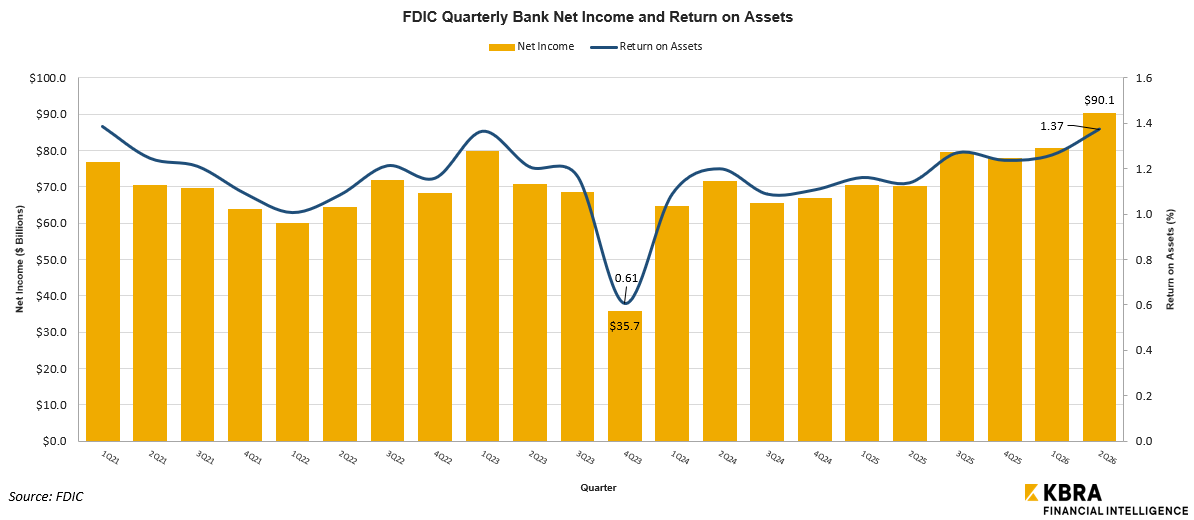
The latest results from the FDIC’s Quarterly Banking Profile show that net income was $90.1 billion for 2Q, up 12% from the prior quarter and 28.7% from the year-ago period. Return on assets was 1.37%, up 11 basis points (bps) quarter-over-quarter (QoQ) and 24 bps year-over-year (YoY). The low point for net income across the roughly five-year period was $35.7 billion in 4Q 2023, as the industry absorbed the impact from “the expense related to a special assessment to recover the estimated loss to the Deposit Insurance Fund attributable to the protection of uninsured depositors following the failure of two banks” earlier that year, according to an FDIC press release.
Other factors that contributed to the decline this period, according to the FDIC, included a host of “nonrecurring, noninterest expenses recognized by large banks during the quarter.” Sayee Srinivasan, chief economist for the American Bankers Association, said in a press release responding to the latest FDIC Quarterly Banking Profile that, despite “continued economic uncertainty,” steady asset and loan growth, higher net income, and improving credit performance all indicate that “the banking industry remains strong.”
Community banks reported an 8.2% jump in net income QoQ, driven primarily by “higher net interest income, noninterest income, and securities gains,” according to the FDIC.
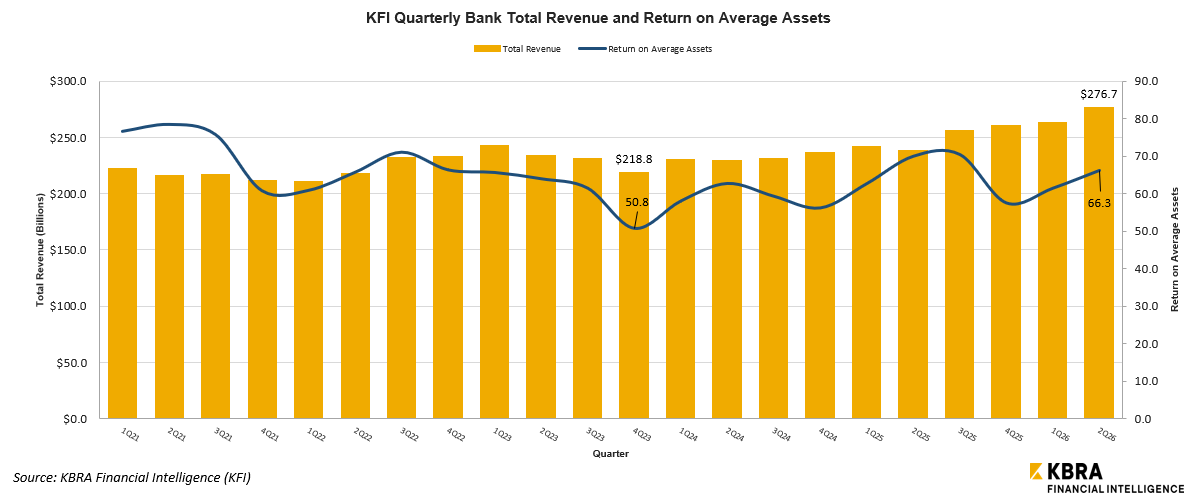
Total bank revenue has steadily increased across the same period, rising to $276.7 billion in 2Q 2026 from $263.2 billion in the prior quarter and $238 billion in the year-ago quarter, according to findings from KBRA Financial Intelligence (KFI) data.
One main growth factor behind the continued performance in total revenue and return on average assets (ROAA) was the increase in loans and other revenue-generating assets held on banks’ books during 1H.
Loan Balances
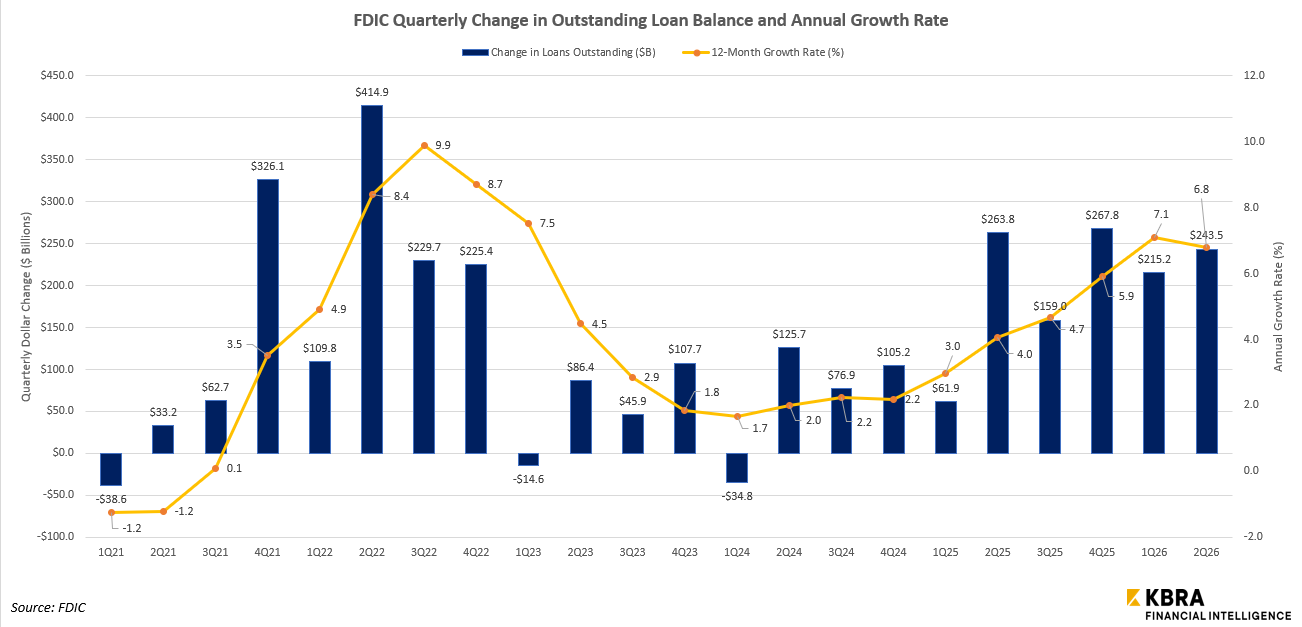
The quarterly dollar change in loans outstanding for 2Q was $243.5 billion, up from $215.2 billion in the prior quarter and down from $263.8 billion in the year-ago period, while the industrywide annual growth rate in loan balances declined slightly to 6.8% from 7.1% in 1Q.
Notable categories that contributed to this increase included loans to nondepository financial institutions (NDFI), commercial and industrial (C&I) loans, and loans to purchase or carry securities, including margin loans.
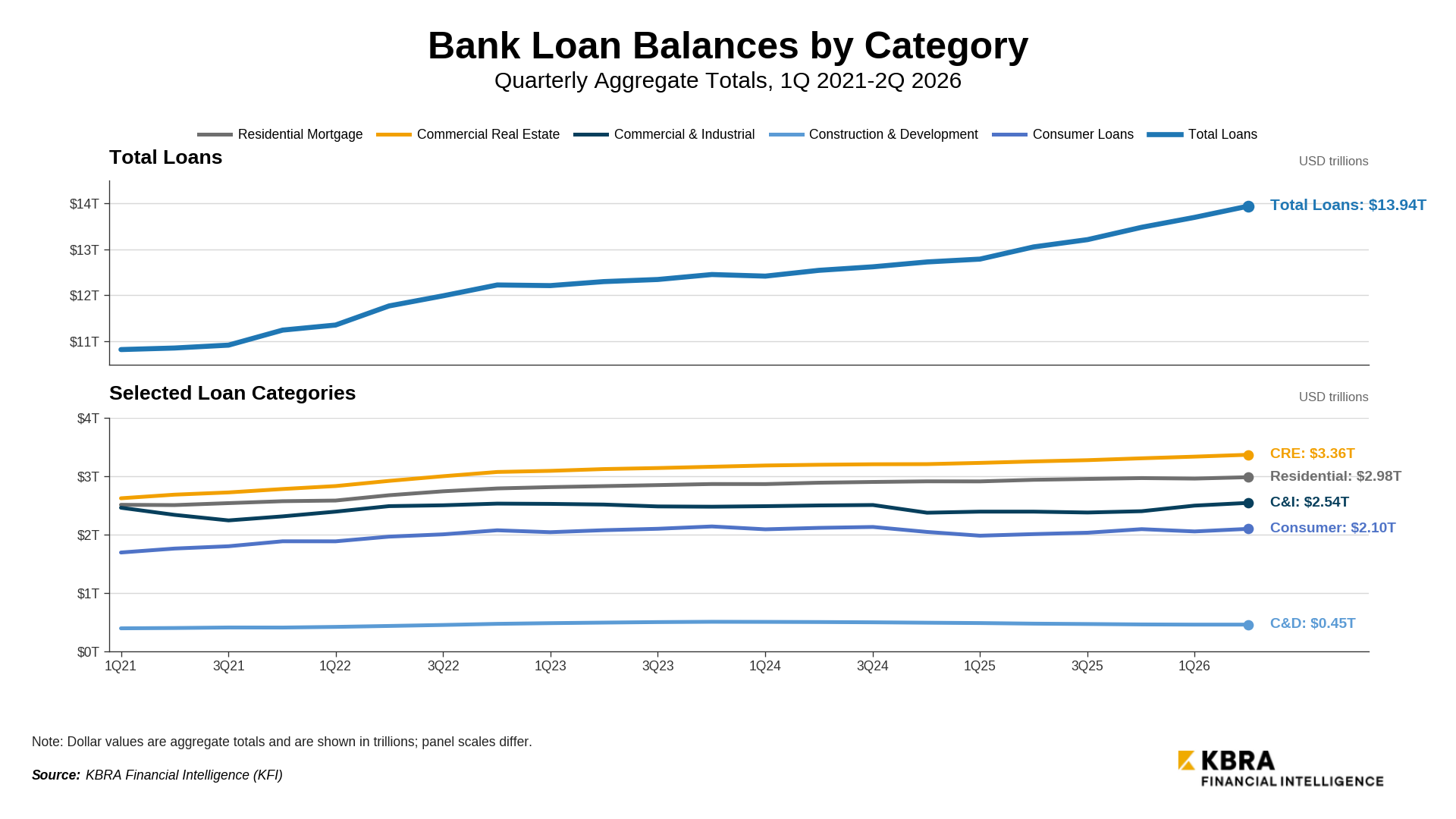
As previously reported in KFI’s 2Q Quarterly Banking Overview, most lending categories reported notable QoQ growth: residential mortgages at 0.81%, consumer loans at 2.16%, C&I loans at 1.87%, and commercial real estate (CRE) loans at 0.96%. Construction and development (C&D) lending was roughly flat, with 0.03% growth from the prior quarter.
Compared to the year-ago period, residential mortgage lending was up 1.53%, consumer lending was up 4.49%, C&I lending was up 6.27%, and CRE lending was up 3.51%. C&D lending was the notable exception, reporting a 3.49% decline YoY.
Deposit Insurance Fund (DIF) Changes
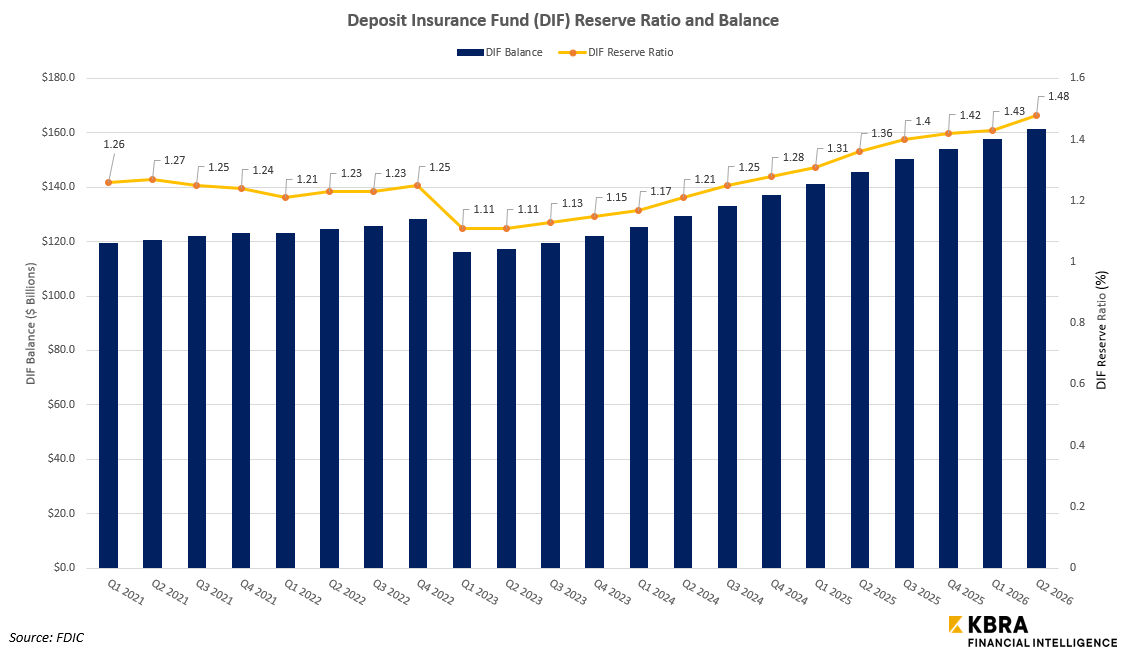
The FDIC’s DIF balance stood at $161.1 billion at the end of 2Q 2026, up $3.7 billion from the prior quarter and $15.8 billion YoY. This was driven mainly by assessment revenue and interest earned from investment securities, which added $2.9 billion and $1.3 billion to the balance, respectively, according to the agency. Further, the FDIC highlighted unrealized losses on available-for-sale securities and operating expenses as two factors that hampered the growth of the DIF balance by roughly $745 million.
A 1% drop in estimated deposits left the DIF reserve ratio at 1.48% for 2Q, 5 bps higher than the prior period and up 12 bps from the year-ago period.
The FDIC’s recent changes to its deposit insurance application procedures for de novo institutions could introduce competing pressures to the DIF balance.
The new 120-day contingent approval time frame, which seeks to “encourage new bank formation, accelerate the speed of the review process, and improve the efficiency of the application process,” per the agency, stands to increase the number of new charters each year. This means that the FDIC would pull in more assessment revenue to help fund the DIF.
At the same time, more de novo institutions likely mean more insured deposits, which increases the denominator when calculating the reserve ratio (DIF balance divided by estimated insured deposits).
Whether the FDIC can offset the impact of new institutions on the DIF balance ultimately depends on whether fund growth can keep pace with growth in insured deposits and any future losses. For bank leaders, that makes the direction of the reserve ratio and the balance between assessment revenue, deposit growth, and loss experience all metrics worth watching alongside industry profitability and credit quality.
KFI can help move that analysis from the industry level to the institution level. Through KFI’s web application and Excel add-in, users can benchmark loan, deposit, earnings, and asset-quality trends across individual banks and peer groups using regulatory and financial data.
To access our full library of KFI data tools and other resources, request a demo with KFI.
Note: Commentary and opinions expressed by individuals who are not affiliated with KBRA Analytics do not necessarily reflect the views of KBRA Analytics, KBRA, or their employees. Such commentary is included solely to provide relevant industry perspectives.