
KFI’s Quarterly Banking Overview: 1Q 2026
Jul 08, 2026, 9:00 AM GMT-4 | By Frank GarganoThe steady growth of bank deposits and loans, fluctuations in bank and credit union KFI scores, and more are among the high points we dive into for this quarter’s edition of KBRA Financial Intelligence’s (KFI) Quarterly Banking Overview.
938 U.S. Banks Saw Raises and Decreases to Their KFI Scores
Source: KBRA Financial Intelligence (KFI)
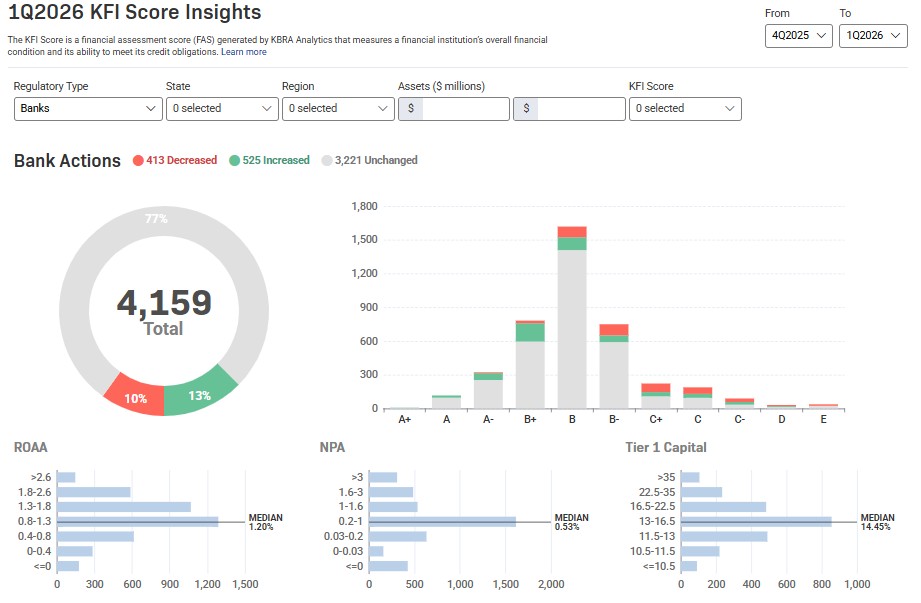
Among the close to 9,000 banks and credit unions scored by KFI for 1Q 2026, 413 institutions saw their scores decrease quarter-over-quarter (QoQ), while 525 banks saw increases in their scores during the same period. Roughly 3,230 banks did not see any material changes to their scores when compared to 4Q 2025.
By contrast, 621 credit unions saw QoQ decreases in their scores, 512 saw increases, and 3,171 institutions had no recorded changes to their scores when compared to 4Q 2025.
For bank holding companies, 34 institutions recorded decreases in their KFI score, 30 showed increases, and 297 were unchanged.
KFI Scores are proprietary quarterly financial assessment scores that measure the financial health of all U.S. banks and credit unions on an A-through-E scale using Federal Financial Institutions Examination Council (FFIEC) and National Credit Union Administration (NCUA) Call Report data. Our models incorporate various asset quality, capital adequacy, earnings performance, and liquidity and funding measures to manage counterparty risk and support robust peer analysis. Access your institution’s KFI Score with a free trial of KBRA Financial Intelligence today.
Bank Deposits Grew Amid Active Regulatory Landscape
Source: KBRA Financial Intelligence (KFI)
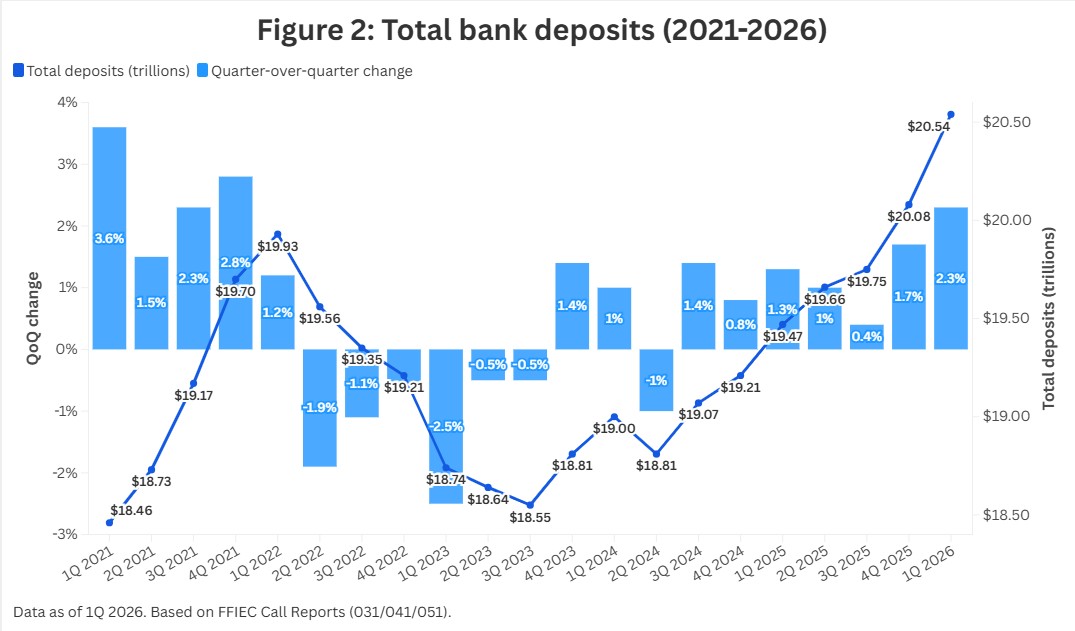
Total bank deposits increased $20.54 trillion in 1Q 2026, a 2.3% increase from the prior quarter’s figure of $20.08 trillion and a continuation of the trending growth from the previous $18.81 trillion low in 2Q 2024. Sayee Srinivasan, chief economist for the American Bankers Association, said in a press release responding to the latest FDIC Quarterly Banking Profile that “the banking industry remained resilient in the first quarter with solid earnings and robust deposit and loan growth.”
“Despite increased market volatility, asset quality metrics remained stable,” Srinivasan said. “America’s banks are well capitalized with strong liquidity to continue supporting their customers and communities.”
In the first three months of the year, four legislative proposals were introduced that, if passed, could significantly change the deposit landscape for banks and credit unions alike.
First is the Main Street Depositor Protection Act, introduced in the U.S. Senate Committee on Banking, Housing, and Urban Affairs on March 25. The proposal would amend the Federal Deposit Insurance Act to raise the deposit insurance coverage limits for noninterest-bearing transaction accounts at banks and credit unions between the standard maximum of $250,000 and $5 million. An earlier version of the bill was introduced in October 2025 and carried a higher ceiling of $10 million instead of the current $5 million.
Financial institutions with $10 billion or less in total assets are exempt from paying special assessments or extra fees to support this expanded coverage tier.
The bill has been met with sharp criticism from activist groups like the National Taxpayers Union, which, in a letter opposing the legislation, expressed concerns about shifting powers, increased reporting burdens, and more.
“If policymakers believe targeted action is needed to address deposit flight during periods of acute financial stress, more limited and temporary solutions should be considered separately. … That question is distinct from establishing a permanent expansion of deposit insurance for higher-balance accounts in normal market conditions,” the letter said.
Next is the Growing Deposit Insurance for the Future Act. The bill aims to update the inflation adjustment applicable to deposit insurance and share insurance
Other efforts worth noting are bills that seek to direct the FDIC and NCUA to establish emergency transaction account guarantee programs for noninterest-bearing deposits held at insured institutions, as well as conduct an analysis to determine whether insurance coverage should be raised on eligible accounts.
Bank Lending Activity Remained Strong
Source: KBRA Financial Intelligence (KFI)
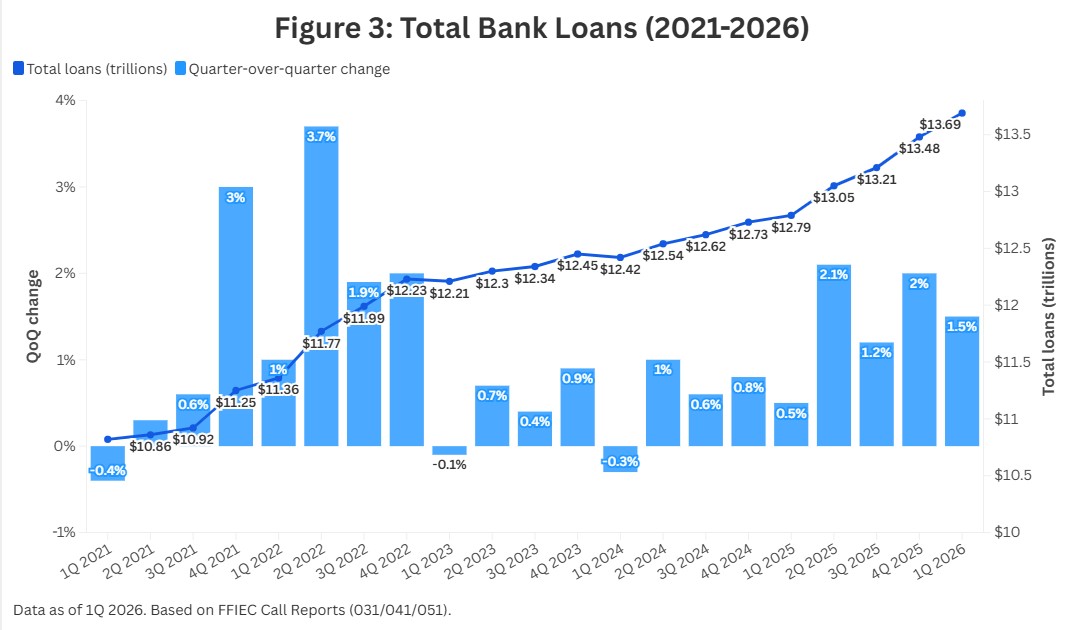
Total bank loans reached $13.69 trillion in 1Q 2026, up 1.5% from $13.48 trillion in 4Q 2025 and up almost $1 trillion compared to the year-ago period.
The metrics above—as well as all data reported by U.S. banks in FFIEC Call Reports, Uniform Bank Performance Reports (UBPR), and Generally Accepted Accounting Principles (GAAP) financials—can be identified and downloaded by utilizing the Data Wizard in KFI’s Excel add-in. To access our full library of KFI Scores and data tools, request a demo with KFI.
In Case You Missed It
Follow KFI Insights for our latest research, data analytics, and product updates. Read our research reports utilizing data from 10,000 banks, credit unions, and more. Some of our recent analysis highlights include the following:
How Could the Bipartisan Housing Bill Upend Mortgage Lending for Banks and Credit Unions?
In His First Meeting as Federal Reserve Chairman, Kevin Warsh Sets a Different Tone from Powell
Loan Quality, Consent Order Were Key Factors Behind the Second Bank Failure of 2026
Note: Commentary and opinions expressed by individuals who are not affiliated with KBRA Analytics do not necessarily reflect the views of KBRA Analytics, KBRA, or their employees. Such commentary is included solely to provide relevant industry perspectives.